Log calculations show up everywhere. Chemistry labs, algebra exams, physics problem sets, engineering coursework — if you spend any time in a STEM field, you already know how often you need to punch in a logarithm and get a clean, accurate result fast. The wrong calculator makes that process clunky and slow. The right one makes it feel effortless.
That’s exactly why this guide exists. We compared five scientific calculators that handle log functions reliably, from budget-friendly picks for middle schoolers to full-featured options for college-level work. Each one was evaluated on display clarity, function depth, build quality, and ease of use for log-heavy coursework.
By the time you finish reading, you’ll know exactly which calculator fits your level, your budget, and your study habits.
How We Selected the Best Scientific Calculators for Log Calculations
Our team spent time reviewing product specifications, real-world user feedback, and hands-on performance details for each calculator on this list. We focused specifically on how well each model supports logarithmic functions, both common (log base 10) and natural (ln), because that’s the core need for most students and professionals shopping in this category.
Here are the factors that shaped our picks:
- Log and exponential function support: We confirmed each calculator includes dedicated log and ln keys, along with the ability to compute inverse logs and handle exponential expressions without workarounds.
- Display quality: A clear, readable display reduces errors during complex multi-step log problems. We looked at display size, contrast, and whether the screen shows expressions in a natural textbook format.
- Function count and depth: More functions mean more versatility across subjects. We noted how many built-in functions each calculator offers and whether those functions cover common coursework alongside logarithms.
- Power reliability: Running out of power mid-exam is a real problem. We paid close attention to whether each model uses solar power, battery backup, or rechargeable options.
- Build quality and portability: A calculator that cracks or gets scratched easily won’t last through a school year. We assessed durability, weight, and how well each unit handles everyday wear.
- Ease of use: We evaluated how intuitive each model is for first-time users, particularly students switching from a basic calculator for the first time.
- Value for money: Price matters. We considered what each calculator delivers relative to its cost, especially for students on tighter budgets.
Every pick on this list earned its spot based on these factors. No filler, no fluff. Let’s get into the reviews.
Best Scientific Calculators for Log Calculations (2026 Expert Review)
Five solid options made this list, ranging from an ultra-portable solar-powered model to a feature-heavy calculator with a built-in notepad. Whether you’re a high school student tackling algebra or a college student working through calculus and chemistry, there’s a match here for you.
1. Casio fx-115ES Plus 2nd Edition — The Gold Standard for Serious Students

If you need a calculator that can do virtually everything a non-graphing scientific calculator should do, the Casio fx-115ES Plus 2nd Edition is the one to beat. It packs over 280 built-in functions into a compact frame, covering everything from basic log calculations to integration, matrix operations, and complex number work. For students moving through calculus, physics, or engineering courses, this calculator handles the full load.
The Natural Textbook Display is a genuine standout feature. Fractions, roots, and logarithmic expressions appear on screen exactly as they’d look written on paper or printed in a textbook. That visual clarity removes a layer of mental translation when you’re working through multi-step problems involving logs and exponents.
The display is a 4-line, 16-digit LCD, which means you can see your full expression and result without scrolling or guessing. We found this especially useful for log-heavy problems where the input expression needs a quick review before you hit equals. The calculator also supports the multi-replay function, so you can backtrack through calculations and edit without starting over.
Power comes from Solar Plus technology with a battery backup, meaning this calculator is nearly impossible to run out of juice in normal use. It weighs practically nothing and fits in any pencil case or backpack pocket without taking up room.
Key Specs:
- Functions: 280+
- Display: 4-line, 16-digit LCD with Natural Textbook Display
- Power: Solar Plus with battery backup
- Dimensions: Approx. 3.1″ x 6.5″
- Suitable for: High school through college-level math and science
- Natural Textbook Display makes log expressions easy to read and verify
- 280+ functions cover calculus, statistics, matrix, and complex number operations
- Solar Plus power means you rarely touch the battery
- Display contrast can be harder to read in poor or glare-heavy lighting
- No dedicated “change sign” key, which some users find mildly inconvenient
2. CATIGA CS-121 Scientific and Graphing Calculator — Versatile Value with Visual Power
UNAVAILABLEThe CATIGA CS-121 brings something the other calculators on this list don’t: graphing capability. At its price point, that’s a notable advantage for students who want to visualize how log and exponential functions behave, not just compute numeric answers. It supports over 360 functions across multiple modes, including fractions, complex numbers, statistics, linear regression, and standard deviation.
This calculator measures 7 x 3.3 inches, which gives it a comfortable, full-sized feel. The button layout is smooth and well-spaced, reducing the chance of miskeys during a timed exam or fast-paced problem session. It’s a good fit for students in algebra, geometry, trigonometry, and entry-level calculus who want a single tool that handles both graphing and scientific work.
Build quality is decent for the price. The anti-drop body is designed to hold up to regular backpack wear, and the calculator ships with a protective case to guard the screen and keys during transport. Battery life holds up well through extended study sessions.
Key Specs:
- Functions: 360+
- Display: 3-inch screen
- Power: Battery powered
- Dimensions: 7 x 3.3 inches
- Calculator Type: Scientific and graphing
- Graphing capability adds visual insight for log and exponential functions
- 360+ functions cover a broad range of high school and college topics
- Protective case included
- Some users report the graphing function does not perform reliably
- Build quality feels less premium compared to Casio models at similar or lower prices
3. Casio fx-300ES Plus 2nd Edition — The Dependable Pick for High School Math
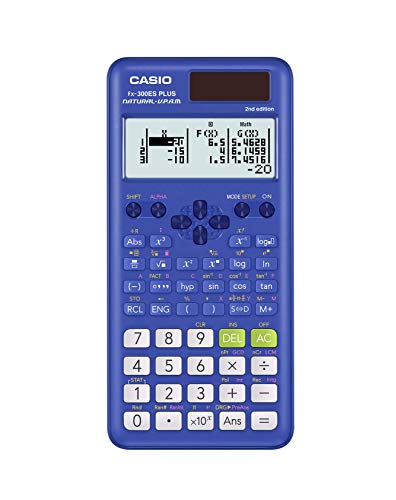
The Casio fx-300ES Plus 2nd Edition doesn’t try to do everything, and that’s exactly what makes it so reliable for its target audience. It’s built for students from middle school through high school, handling pre-algebra, algebra, geometry, trigonometry, and statistics with ease. The 262 built-in functions cover every log and trig operation a high school student will encounter, without overwhelming a newer user with features they won’t touch for years.
Like its more advanced sibling, this calculator uses Casio’s Natural Textbook Display, so logarithms and fractions appear on screen exactly as they look in a textbook. The display is 6.25 centimeters and shows both the input expression and the result, which is especially helpful when double-checking log calculations before moving to the next step. We also appreciated the two-function table feature, which lets you build value tables for f(x) and g(x) — genuinely useful for understanding how log functions behave across a range.
The build is compact and light, measuring 0.5 x 3.1 x 6.4 inches. It fits easily in any backpack or desk drawer and comes with a protective sliding hard case. Solar Plus power with a battery backup means you aren’t scrambling for batteries before an exam.
Key Specs:
- Functions: 262
- Display: 6.25 cm Natural Textbook Display
- Power: Solar Plus with battery backup
- Dimensions: 0.5″ x 3.1″ x 6.4″
- Suitable for: Middle school through high school
- Natural Textbook Display for clear log and fraction input
- Two-function table helps visualize logarithmic behavior
- Solar Plus with battery backup
- Compact with protective sliding case
- Not suited for calculus-level or college engineering coursework
- Only 2 lines on display; complex expressions may feel cramped
4. ROATEE 991ES Scientific Calculator with Notepad — The Smart Study Companion
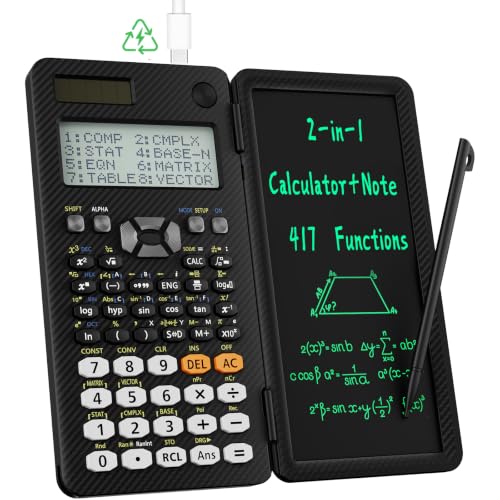
The ROATEE 991ES does something none of the other calculators on this list do: it gives you a built-in LCD writing tablet right alongside the calculator. If you’ve ever needed to jot down an intermediate log value or a quick conversion factor mid-problem, you’ll understand immediately why that matters. The stylus pen clips neatly into the calculator body, and the notepad locks with a dedicated switch so you don’t accidentally wipe your notes.
Function-wise, this calculator is one of the most capable on the list. It offers 417 built-in functions, covering everything from base-N calculations and complex numbers to matrix operations, equation solving, vector math, and calculus. For log work specifically, it handles both common and natural logarithms, along with exponential expressions and statistical calculations that often appear alongside log functions in chemistry and physics.
The 4-line display shows four calculations on screen at the same time, which is genuinely helpful when working through multi-step problems. The body is rechargeable via coin battery and designed with an anti-drop frame, so it holds up to the usual knocks of student life. At just 5 ounces, it’s easy to carry.
Key Specs:
- Functions: 417
- Display: 4-line, 6.2 cm LCD
- Power: Rechargeable coin battery
- Weight: 5 oz
- Includes: LCD writing tablet with lock/unlock switch and stylus pen
- Built-in lockable LCD notepad for jotting notes mid-calculation
- 417 functions, among the highest on this list
- 4-line display shows multiple calculations simultaneously
- Writing tablet can be dim in low-light conditions
- More complex to set up than a standard scientific calculator for new users
5. Casio fx-260 Solar II — The Exam-Ready Budget Pick
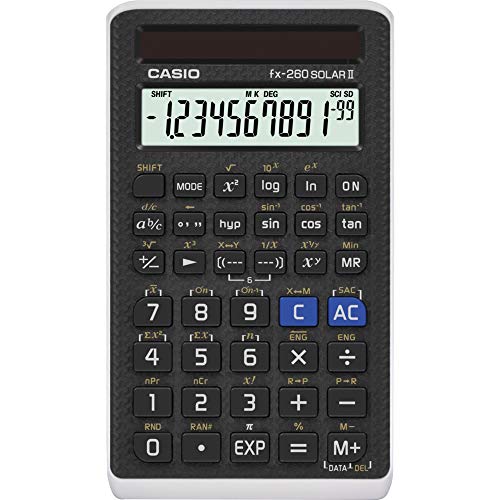
The Casio fx-260 Solar II earns its place on this list by doing the essentials exceptionally well at a price that’s hard to argue with. It’s Casio’s most compact scientific calculator, and it’s approved for use on the SAT, PSAT, ACT, NMSQT, and AP exams — a crucial detail for test-takers who need a permitted model. It handles logarithms, trigonometric functions, standard deviation, fraction calculations, and exponential operations without any complications.
The 10-digit display is clear and easy to read in normal lighting, and the calculator ships with a hard case cover that snaps on securely. The form factor is genuinely pocketable. We found the compact size a real advantage for students who carry a lot between classes and don’t want a heavy calculator adding to the load.
Power is 100% solar, with a battery backup for dark environments. The calculator runs on a single LR-44 battery that Casio estimates lasts around three years with typical daily use. That’s about as maintenance-free as a calculator gets.
Key Specs:
- Display: 10-digit LCD (2.25 inches)
- Power: Solar with LR-44 battery backup
- Exam approval: SAT, PSAT, ACT, NMSQT, AP
- Includes: Hard case cover
- Suitable for: Middle school through high school; standardized test use
- Approved for SAT, ACT, AP, and PSAT exams
- Fully solar powered with battery backup
- Extremely compact and portable
- Single-line display limits visibility of full expressions during complex log work
- Not suitable for calculus or college-level coursework
Best Scientific Calculators for Log Calculations: A Quick Rundown
- Casio fx-115ES Plus 2nd Edition: Best overall for college-level math and science, with 280+ functions and Natural Textbook Display
- CATIGA CS-121: Best for students who want graphing capability alongside scientific functions at a budget-friendly price
- Casio fx-300ES Plus 2nd Edition: Best for high school students who need a reliable, easy-to-use scientific calculator for everyday coursework
- ROATEE 991ES with Notepad: Best for students who want a high-function calculator and a built-in notepad in one compact package
- Casio fx-260 Solar II: Best for standardized test use and anyone who wants a simple, durable, exam-approved calculator at the lowest price
Final Thoughts
Picking the right scientific calculator for log calculations comes down to how much you need it to do and where you’ll be using it. A high school student preparing for an algebra exam has very different requirements from a college student working through thermodynamics or a chemistry lab. Function count matters, but so do display clarity, power reliability, and whether the model is approved for the exams you’re taking.
The good news is that every calculator on this list handles logarithms well at its level. Focus on what fits your current coursework, your typical study environment, and how much you’re willing to spend. The right tool is the one you’ll actually reach for when a problem gets hard.