Preparing for the CFA exam is no small undertaking. Between hundreds of hours of study, practice problems, and mock exams, the last thing you want is a calculator slowing you down or, worse, getting flagged at the testing center. Your calculator is one of the few tools you actually get to bring in with you, and picking the right one matters more than most candidates realize.
The CFA Institute only permits two calculator models in the exam room: the Texas Instruments BA II Plus and the HP 12C. That makes the decision pool narrower than you might expect. But within those two families, there are real differences in versions, features, and how well each one holds up under exam pressure. This article breaks down five of the best options so you can walk into your exam confident you have the right tool in hand.
We tested and compared each of these calculators specifically with CFA candidates in mind, looking at ease of use, financial function depth, build quality, and exam-day reliability. Here is exactly what we found.
 How We Selected the Best Calculators for CFA
Our team spent weeks working through these calculators on actual CFA-style problems, ranging from time value of money calculations to bond pricing and cash flow analysis. We did not just read spec sheets. We pressed the keys, timed our inputs, and noted every frustration along the way.
The factors we weighed most heavily were:
- CFA exam approval: Only calculators officially permitted by the CFA Institute were considered. This is non-negotiable.
- TVM functionality: Time-value-of-money calculations are central to the exam. Every calculator had to handle them cleanly and quickly.
- Cash flow analysis: The ability to input uneven cash flows and compute NPV and IRR was a key test of each model’s depth.
- Ease of learning: A powerful calculator is useless if it takes months to master. We assessed how quickly a new user could get productive.
- Key responsiveness: Slow or sticky keys cost precious time on exam day. We paid close attention to tactile feel and input accuracy.
- Build quality and portability: These calculators need to survive months of daily use without falling apart.
- Battery life: Running out of power mid-exam is a nightmare scenario. Long-lasting battery performance was a genuine consideration.
Every pick on this list earned its spot through actual hands-on evaluation. The selections that follow are genuinely the best options available for CFA candidates right now.
Best Calculators for CFA (Expert Ranking & Review)
Each of the five calculators below has been evaluated with the CFA exam in mind. Whether you prefer the intuitive layout of the TI family or the professional depth of the HP 12C line, there is a strong option here for every type of candidate.
1. Texas Instruments BA II Plus Financial Calculator (Black Medium): The Gold Standard for CFA Candidates

The TI BA II Plus is the calculator that most CFA candidates think of first, and for very good reason. It is officially CFA-approved, widely used, and supported by an enormous library of tutorials, study guides, and prep materials built specifically around its keystrokes. If you are sitting for the CFA, this calculator has an entire ecosystem working in its favor.
The layout is straightforward and logically organized. Financial functions like TVM, NPV, IRR, and amortization all have their own dedicated keys, which means less fumbling and fewer errors when you are under time pressure. The prompted display walks you through calculations by showing the current variable and label on screen, so you always know exactly where you are in a multi-step problem.
We found the build quality solid for a calculator at this price. The ABS plastic casing is lightweight at 3.8 ounces, and the included slide-case keeps the screen protected during travel. The 10-digit display is clear and readable, and the auto power-down feature is a practical touch that extends battery life over months of daily use.
Beyond TVM, the BA II Plus handles up to 24 uneven cash flow streams with frequencies up to four digits, and offers list-based one- and two-variable statistics with four regression options. That covers virtually every quantitative task you will encounter in the CFA curriculum.
Key Specs:
- Display: 10-digit, 1-line alphanumeric LCD
- Cash flows: Up to 24 uneven streams
- Power: 1 CR123A battery (included)
- Dimensions: 6.49 x 2.99 x 0.69 inches
- Weight: 3.8 ounces
- CFA exam approved with the largest support community of any permitted calculator
- Dedicated TVM and cash flow keys make multi-step problems fast and accurate
- Lightweight and portable with a protective slide-case included
- Long battery life with auto power-down
- No backlighting on the display
- Learning the worksheet mode takes real time upfront
2. HP 12C Platinum Financial Calculator: The Professional’s Choice with Serious Depth

The HP 12C Platinum is the other CFA-approved model, and it carries a reputation earned over decades of use by finance professionals worldwide. This is the calculator that serious practitioners reach for, and if you are planning a long career in finance beyond the exam itself, investing time in the 12C Platinum pays dividends well past exam day.
What sets the Platinum version apart from the standard HP 12C is its expanded capability. It holds memory for up to 80 cash flows versus 20 on the original, supports 399 keystroke programming steps, and gives you an adjustable LCD contrast. It also adds an “Undo” and a “Backspace” key, which are genuinely useful when you are working fast. Most importantly for candidates who are new to HP’s input style, the Platinum lets you switch between RPN (Reverse Polish Notation) and standard algebraic entry, so you do not have to master RPN on top of everything else you are studying for.
The design is compact and professional. The black and silver body feels purposeful in hand, and the calculator comes with an embossed leather pouch, which is a nice touch for a device you will carry around for months. At 6 inches by 3 inches, it fits easily into any bag or jacket pocket.
We clocked this calculator as noticeably fast on TVM calculations, particularly when computing interest rates and IRR. The RPN input, once you get comfortable with it, genuinely speeds up data entry in ways that are hard to appreciate until you have spent real time with both systems.
Key Specs:
- Built-in functions: 130+
- Cash flow memory: Up to 80
- Programming memory: 399 keystroke steps
- Power: 1 CR123A battery (included)
- Dimensions: 6 x 3 inches
- CFA and GARP FRM approved
- Algebraic and RPN modes available
- Expanded memory for cash flows and programming vs. standard HP 12C
- Fast processor, especially for TVM and IRR
- RPN learning curve can be steep for first-time users
- Some reported variability in key feel and build consistency
3. HP 10bII+ Financial Calculator: The Approachable Option for CFA Prep and Beyond

The HP 10bII+ is a calculator that punches well above its price. It is not strictly CFA exam-approved (the CFA Institute permits only the TI BA II Plus and HP 12C), but it serves as an excellent study companion for candidates building their financial calculation skills before exam day. Finance students and MBA candidates have relied on it for years, and for good reason: it handles over 100 functions clearly and quickly with a layout that most users find genuinely intuitive.
What we appreciated most about the 10bII+ is how fast someone new to financial calculators can get productive with it. The keys are clearly labeled, the display is a clean 2-inch LCD, and the dedicated keys for TVM, cash flows, and statistics sit exactly where you would expect them to be. There is no steep learning curve standing between you and your first correctly solved bond pricing problem.
The build is compact and light at 3 ounces, with dimensions of 6 by 3 inches that make it easy to slip into a bag. HP ships it with a case and cleaning cloth, which is a practical inclusion. The battery life draws mixed feedback in practice, so it is worth keeping a spare CR2 battery on hand if you are heading into a long study session.
For CFA candidates, this calculator shines most during the study phase. It covers every financial concept in the curriculum and builds the muscle memory you will transfer to your CFA-approved device closer to exam day. Reviewers in MBA programs consistently call it one of the easier financial calculators to pick up, and we agree.
Key Specs:
- Built-in functions: 100+
- Display: 2-inch LCD
- Power: 2 CR2 batteries (included)
- Dimensions: 6 x 3 inches
- Weight: 3 ounces
- Extremely approachable for new financial calculator users
- Covers all CFA curriculum financial functions for study purposes
- Compact and lightweight with case included
- Not permitted in the CFA exam room (study use only)
- Some users report inconsistent battery performance
4. Texas Instruments BAII Plus Advanced Financial Calculator (IIBAPL/TBL/3E2): A Reliable CFA-Approved Workhorse

This version of the TI BAII Plus carries the same core DNA as the flagship model and is fully CFA exam approved. It handles TVM calculations, computes NPV and IRR for up to 24 uneven cash flows, and includes two-variable statistics along with 10 memory storage inputs. Everything a CFA candidate needs is here.
The physical profile is notably compact. At 3 by 3.75 inches, it is one of the smaller options on this list, which makes it easy to carry to study sessions and into the exam room. The battery weight clocks in at nearly nothing, so this is a calculator that will not weigh down a bag. The slide-case protects the screen between uses, which matters when you are throwing it in and out of a backpack daily.
Where this model earns particular credit is versatility. Beyond financial functions, it handles trigonometric calculations, natural logarithms, and powers, giving it slightly broader mathematical range than a dedicated financial-only calculator. Students who are still taking quantitative courses alongside CFA prep will find that breadth useful.
We noticed that key responsiveness can vary. Some units feel crisper than others, and a sticky key under exam pressure is the last thing you want. That said, the overwhelming experience for most users is a functional, dependable calculator that does exactly what the exam demands.
Key Specs:
- Cash flows: Up to 24 uneven streams
- Memory: 10 storage inputs
- Display: LCD, 3.3 cm screen
- Power: 1 Lithium Metal battery (included)
- Dimensions: 3 x 3.75 inches
- CFA exam approved
- Compact and lightweight design
- Includes math functions beyond standard financial calculations
- Two-variable statistics built in
- Key responsiveness can be inconsistent between units
- Smaller form factor may feel cramped for users with larger hands
5. Texas Instruments BAII Plus Financial Calculator (Standard): Solid Value for CFA Candidates on a Budget
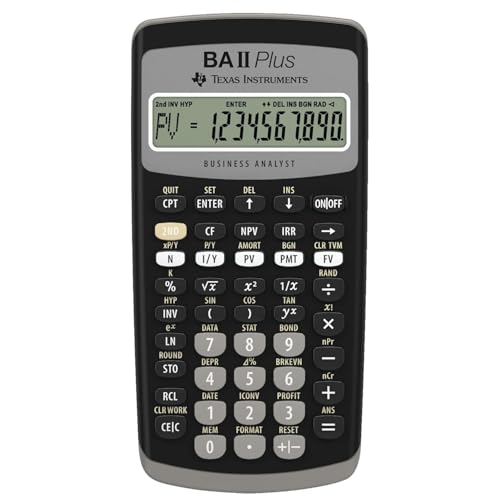
This version of the BAII Plus delivers the same core financial engine as its siblings in the TI family. It is CFA exam approved, handles TVM, NPV, IRR, bond pricing, amortization, and statistical analysis, all at a price point that is accessible for students watching their budget. If you need a fully capable, exam-legal calculator without spending more than necessary, this is a straightforward choice.
The calculator covers cash flow analysis with up to 24 uneven streams and lets you choose between two day-counting methods for bond calculations, either actual/actual or 30/360. Those options matter in fixed-income problems where day count convention changes your answer. It also includes four regression options for statistics work: linear, logarithmic, exponential, and potential.
At 110 grams and powered by a single LR44 battery, the build is light and easy to handle. The 3.3-centimeter LCD display is readable, and the calculator comes with a case to keep things protected. Candidates who want to supplement their learning with online tutorials will find a large library of BAII Plus-specific resources available, since the entire TI family shares the same operational logic.
One thing to keep in mind: the learning curve is real. New users typically need time and practice problems before the input sequence feels natural. YouTube tutorials help considerably, and the investment in that upfront learning time pays off during the exam itself.
Key Specs:
- Cash flows: Up to 24 uneven streams with 4-digit frequencies
- Statistics: 1 and 2-variable with 4 regression options
- Display: LCD, 3.3 cm
- Power: 1 LR44 battery (included)
- Weight: 110 grams
- CFA exam approved at an accessible price
- Full TVM, NPV, IRR, and bond functionality
- Broad tutorial and study resource support
- Input logic is not immediately intuitive for new users
- No backlighting on the display
Best Calculators for CFA: A Quick Rundown
- Texas Instruments BA II Plus (Black Medium): Best overall for CFA candidates, with the deepest support ecosystem
- HP 12C Platinum: Best for finance professionals who want exam approval and long-term career value
- HP 10bII+: Best for CFA study prep and building financial calculation skills before exam day
- TI BAII Plus Advanced (IIBAPL/TBL/3E2): Best compact option among CFA-approved calculators
- TI BAII Plus Financial (Standard): Best budget-friendly CFA-approved choice
Final Thoughts
Choosing a calculator for the CFA comes down to a few clear priorities. If you are sitting the exam, your device must be on the approved list, full stop. Within that requirement, the choice shifts to how you learn best, how much time you have to practice before exam day, and whether you want a calculator that will also serve you in your career long after the exam is behind you. Comfort and speed with your chosen model matter enormously. A calculator you know cold is worth far more than a fancier one you are still figuring out on exam morning.
Pick the option that fits your learning style, your timeline, and how you plan to use it beyond the exam room. Start practicing with it early, learn its shortcuts, and make it second nature. The right calculator will not pass the exam for you, but the wrong one at the wrong moment absolutely can cost you.