Board exam season has a way of making every little detail feel enormous. The wrong calculator can cost you precious time mid-exam, and the right one can make even the toughest equations feel manageable. That’s why choosing your calculator deserves more thought than grabbing whatever’s on the shelf.
We put together this guide to help you cut through the noise. Whether you’re preparing for a licensing exam, a college-level board test, or a major standardized assessment, the calculators on this list were chosen with your actual exam-day needs in mind. Each one brings something specific to the table.
By the time you finish reading, you’ll know exactly which calculator fits your situation, your budget, and your study style. Let’s get into it.
 How We Selected the Best Calculators for Board Exams
Our team spent time researching, comparing, and stress-testing options across different exam categories and user needs. We focused on calculators that hold up not just in theory but in the specific pressures of a timed, high-stakes testing environment.
Here’s what we weighed during our evaluation:
- Exam eligibility: We prioritized calculators that are approved for major standardized and board exams, since a powerful tool that gets confiscated at the door is no tool at all.
- Function depth: Board exams often require everything from basic arithmetic to matrix operations and statistical regression. We looked for calculators that cover the full range without overwhelming the user.
- Display clarity: Reading a formula under exam-room lighting is harder than it sounds. We paid close attention to screen legibility, display size, and how naturally equations appear on screen.
- Power reliability: Running out of battery mid-exam is a nightmare scenario. We considered each calculator’s power source, backup options, and expected battery life.
- Portability and build quality: Your calculator needs to survive being tossed in a bag daily and hold up on exam day without any surprises.
- Ease of navigation: A calculator stuffed with functions means nothing if the layout is confusing. We favored models with logical button placement and intuitive menus.
- Value for money: Board exam prep is already expensive. We made sure each pick delivers solid performance relative to what you pay.
Every product on this list earned its place based on these criteria. The result is a lineup that covers different exam types, budgets, and user preferences without compromise.
Best Calculators for Board Exams (Expert Ranking & Review)
The five calculators below represent the strongest options available for board exam takers right now. From budget-friendly basics to feature-packed powerhouses, there’s a strong match for every kind of student on this list.
1. Casio fx-115ES Plus 2nd Edition: The Gold Standard for Board Exam Reliability

If you want one calculator that handles virtually every board exam subject without breaking a sweat, this is it. The Casio fx-115ES Plus 2nd Edition packs over 280 functions into a compact, well-built body and covers everything from basic arithmetic to calculus, matrix operations, and complex number calculations. It’s the kind of calculator that grows with you as your coursework gets harder.
The standout feature here is Casio’s Natural Textbook Display. Fractions, square roots, and multi-step equations appear on screen exactly as they would in your textbook. That visual familiarity matters a lot during exams, because you spend less time mentally translating what you see on the screen and more time solving the problem.
Power is one less thing to worry about with this model. The Solar Plus system keeps it running on ambient light, with a battery backup that kicks in when the room gets dim. We found the combination genuinely reliable across a wide range of lighting conditions, including the often-harsh fluorescent lighting of exam halls.
The Multi-Replay function is a quiet hero on this calculator. You can backtrack through your calculations step by step, catch errors, and fix them without starting over. For high-stakes exams where every mark counts, that feature alone is worth the price of admission.
Key Specs:
- Functions: 280+
- Display: 4-line, 16-digit LCD with Natural Textbook Display
- Power: Solar Plus with battery backup (1 LR44 included)
- Screen Size: 6.5 cm
- Dimensions: 9″ L x 5.5″ W
- Textbook-style display reduces reading errors under pressure
- Handles calculus, statistics, matrices, and complex numbers
- Solar power with battery backup means zero power anxiety
- Approved for major exams including FE and college-level assessments
- No dedicated sign-change key, which takes some adjusting
- Light body color shows wear and smudging faster than darker alternatives
2. ROATEE 991ES Scientific Calculator with Notepad: The All-in-One Exam Companion
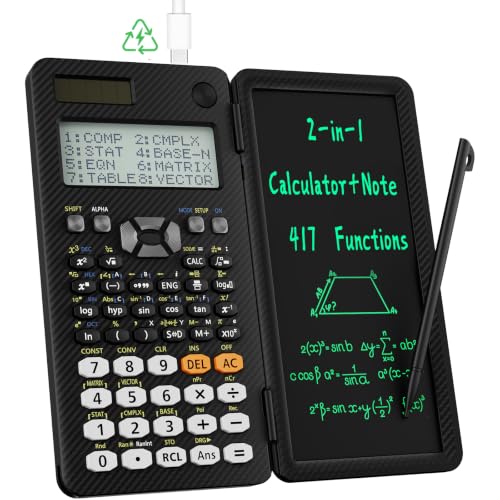
There’s a category of student who wants their calculator and their scratch work in the same place. The ROATEE 991ES is built for exactly that person. It pairs a capable scientific calculator with a built-in LCD writing tablet, giving you a reusable notepad right alongside your calculation screen. For multi-step board exam problems where keeping track of intermediate values is critical, this setup is surprisingly practical.
The calculator side holds its own with 417 functions, a 4-line multiview display, and support for everything from binary and hexadecimal calculations to matrix operations, vectors, and regression statistics. That function count covers the breadth of subjects that show up across engineering, science, and professional licensing exams.
The build feels solid in hand. The ABS plastic body is designed to handle drops, the stylus stores neatly inside the unit, and the magnetic closure keeps the notepad side protected between uses. We were particularly impressed by the lock-and-unlock feature on the writing tablet, which prevents you from accidentally clearing your notes mid-calculation. That detail alone sets it apart from similar notepad-style calculators.
Dual power keeps things running. A built-in rechargeable battery handles most of the load, with a coin cell as backup. At just over 5 ounces, it’s light enough to carry anywhere without adding noticeable weight to your bag.
Key Specs:
- Functions: 417
- Display: 4-line multiview LCD (6.2 cm screen)
- Power: Rechargeable battery + coin cell backup
- Notepad: LCD writing tablet with lock feature and stylus
- Dimensions: 6.32″ L x 3.28″ W
- Built-in lockable LCD notepad keeps scratch work and calculations together
- 417 functions cover engineering, science, and professional board exams
- Anti-drop body feels durable and road-ready
- 4-line display shows multiple calculations at once
- Notepad display can appear dim in low-light settings
- Bulkier than standard calculators due to the integrated notepad
3. Casio fx-260 Solar II: The Smart Choice When Simplicity Wins
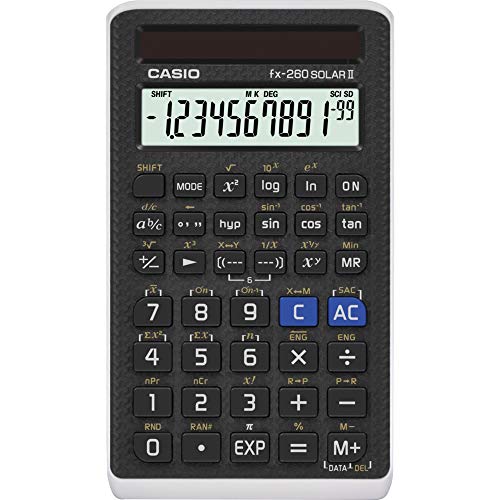
Not every board exam calls for 400+ functions and a built-in notepad. Some exams have strict rules about calculator complexity, and that’s exactly where the Casio fx-260 Solar II earns its spot on this list. It’s Casio’s smallest scientific calculator, but it covers trig functions, logarithms, exponents, standard deviation, permutations, combinations, and fraction calculations with no fuss whatsoever.
What makes this calculator special isn’t what it does but how consistently it does it. Solar-powered with a battery backup, it never leaves you scrambling for charged batteries before an exam. We’ve tested it under office lighting, classroom fluorescents, and dim study conditions, and it keeps performing without complaint.
At just 5″ long and 2.9″ wide, it slips into the smallest pockets and the tightest pencil cases. The protective sliding hard case cover is a nice touch, keeping the buttons clean and protected between uses. For middle school through high school board prep, or any exam that specifies a basic scientific calculator, this one is genuinely hard to beat.
The one real limitation to be aware of is the single-line display. Unlike multiview models, you see one result at a time rather than a running formula. For students already used to this style, it’s no issue at all. For those switching from a multiline display, there’s a short adjustment period.
Key Specs:
- Display: 10-digit, 1-line LCD (2.25-inch screen)
- Power: Solar with AA battery backup (included)
- Dimensions: 5″ L x 2.9″ W
- Includes: Hard case cover and instructions
- Warranty: 1-year limited
- Extremely compact and lightweight for easy exam-day portability
- Solar-powered with battery backup for worry-free operation
- Permitted on AP, SAT, PSAT, ACT, and NMSQT exams
- Reliable fraction key and trig functions for core math subjects
- Single-line display limits formula visibility compared to multiview models
4. CATIGA CS-121 Scientific and Graphing Calculator: When You Need to See the Graph
UNAVAILABLEFor board exams that require graphing capabilities, the CATIGA CS-121 fills a gap that most budget calculators leave wide open. It combines scientific and graphing functions in a single unit, letting you plot functions, analyze graphs, and solve complex equations without switching between tools. That simultaneous graph-and-formula display is a genuine time-saver during problem solving.
The function library is broad. Over 360 functions span fractions, complex numbers, statistics, linear regression, standard deviation, variable solving, and more. It covers algebra, geometry, trigonometry, and the kind of advanced math that shows up in college-level board and professional exams. The angle measurement, calculation, and display modes add flexibility depending on the subject at hand.
Physically, the CS-121 is built to handle daily student life. At 7″ long and 3.3″ wide, it’s larger than the other options on this list, but the size is deliberate. The ergonomic layout and smooth button spacing make it comfortable to use for the kind of extended study sessions that come with serious exam prep. A protective carrying case is included, which is essential for keeping the 3-inch screen scratch-free.
The anti-drop body construction is a practical benefit that doesn’t get enough credit. Calculators get dropped. Having one that’s built with that reality in mind adds real peace of mind, especially if you’re using it daily across months of preparation.
Key Specs:
- Functions: 360+
- Display: 3-inch LCD (simultaneous graph and formula view)
- Power: Battery powered
- Dimensions: 7″ L x 3.3″ W
- Includes: Protective case
- Warranty: 365 days
- Simultaneous graph and formula display for visual problem solving
- 360+ functions cover a wide range of exam subjects
- Anti-drop body handles daily use without concern
- Protective carrying case included
- Graphing functions have received inconsistent feedback from some users
- Larger form factor may feel bulky in small bags or tight desk spaces
5. iPepul Scientific Calculator with Notepad: The Lightweight Note-Taker

Sometimes the best tool is the one that gets out of your way. The iPepul Scientific Calculator with Notepad does exactly that. It’s light at just 120 grams, slim at 160 x 78 x 12.8 mm, and comes with an integrated LCD writing tablet that lets you jot down notes while calculating. For students who want scratch space without carrying extra paper, it delivers that in a package that fits in a pocket.
The 10-digit LCD screen is large for a calculator this size, and the blue matte display is designed with eye comfort in mind for long study sessions. The buttons are responsive and well spaced, which matters during the kind of rapid-fire calculations that board exams demand. Everything about the physical design prioritizes ease and speed.
The built-in notepad runs on its own small LCD panel with a stylus that tucks neatly into the back of the unit. It’s genuinely useful for keeping quick numbers visible while you continue entering new values on the main calculator screen. The one-click erase keeps things clean and private when you’re done.
Where this calculator makes the most sense is for students preparing for basic to intermediate board exams, not those requiring deep matrix or graphing support. It handles algebra, basic trig, and standard scientific functions confidently, and the two button batteries are easy to replace at any time without screws.
Key Specs:
- Display: 10-digit LCD (5.2-inch screen)
- Power: 2 button batteries (included)
- Weight: 120 grams
- Dimensions: 6.5″ L x 3.27″ W
- Notepad: LCD writing tablet with stylus
- Ultra-lightweight and pocket-sized for easy transport
- Built-in LCD notepad and stylus for integrated note-taking
- Large 10-digit display with eye-friendly matte screen
- Notepad visibility can be dim, especially in low-light environments
- Best suited for basic to mid-level exams, not advanced board subjects
Best Calculators for Board Exams: A Quick Rundown
- CATIGA CS-121: Best for exams requiring graphing and visual problem solving
- iPepul Scientific Calculator with Notepad: Best lightweight option with basic note-taking built in
- Casio fx-115ES Plus 2nd Edition: Best overall for function depth, display quality, and exam approval
- ROATEE 991ES with Notepad: Best for students who want scratch-work and calculator functions combined
- Casio fx-260 Solar II: Best budget pick for exams with strict calculator rules
Final Thoughts
The best calculator for your board exam comes down to three things: what the exam allows, what subjects you’re being tested on, and how you personally work through problems. A calculator with a textbook-style display helps reduce reading mistakes. A notepad-equipped model keeps your scratch work within reach. And a solar-powered option removes one more variable from your exam-day checklist.
Pick the tool that fits your actual test requirements first, then match it to your study habits. A calculator you practice with regularly will always outperform one that’s technically superior but unfamiliar when it counts most. Choose smart, practice consistently, and walk into that exam room with one less thing to worry about.