The Licensure Examination for Teachers is one of the most important tests you’ll ever sit for. Every advantage counts, and the calculator in your hand is part of your preparation kit. Pick the wrong one and you’re fighting your tool when you should be focusing on the problem.
The good news is that you don’t need to spend hours hunting through spec sheets and forum threads. We did that work for you. This guide covers five of the best calculators for the LET exam right now, with honest breakdowns of what each one does well and where it falls short.
By the time you reach the end, you’ll know exactly which calculator fits your exam strategy, your budget, and your comfort level at the test table.
 How We Selected the Best Calculators for LET Exam
Our team evaluated dozens of options across multiple price points, narrowing the list down to five calculators that genuinely hold up under exam pressure. We focused on real-world usability, not just feature counts on a spec sheet.
Here are the factors that guided every decision:
- Exam compliance: A calculator that isn’t allowed in the testing room is a calculator you can’t use. We only considered models with established records of being accepted in standardized exam settings.
- Function range: The LET covers mathematics and general education subjects. A good exam calculator needs to handle statistical calculations, fractions, trigonometry, and algebraic expressions without fuss.
- Display clarity: Reading a result wrong under pressure can cost you a question. We paid close attention to how easily each display communicates information, especially in varied lighting.
- Ease of use: A calculator packed with features you can’t access quickly is a liability. We weighed how intuitive each layout is for someone working at exam pace.
- Durability and build quality: Exam day is stressful. Your calculator needs to hold up through review sessions, mock exams, and the real thing without developing key issues or screen problems.
- Power reliability: Running out of battery mid-exam is a nightmare scenario. We considered how each model handles power, including backup options and battery life.
- Value for money: Not every test-taker has a large budget. We evaluated what each calculator delivers relative to what it costs.
Every pick on this list earned its spot through that process. We’re confident in each recommendation, and here’s where the real detail begins.
Best Calculators for LET Exam (Expert Ranking & Review)
The five calculators below represent the strongest options across different needs and budgets. Whether you want the most powerful tool on the market or a straightforward, no-nonsense scientific calculator, there’s a strong match in this lineup.
1. HP Prime G2 — The Powerhouse Pick for Serious Test-Takers
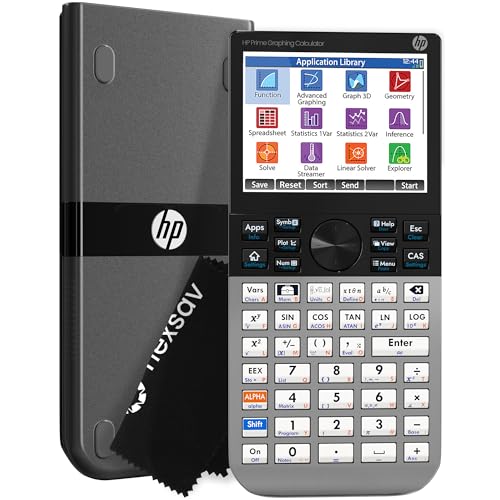
The HP Prime G2 is a different class of calculator. It packs a full Computer Algebra System, dynamic geometry tools, advanced graphing, spreadsheet functions, and RPN support into one brushed-metal device. For anyone preparing for a challenging exam and wanting every mathematical tool available, this is it.
The 3.5-inch multi-touch color display is the standout feature you notice first. Pinch-to-zoom on a graph, sketch a function with your finger, or customize the background to match your workflow. It behaves more like a small touchscreen device than a traditional calculator, and that responsiveness genuinely speeds up complex work.
Build quality is exceptional. The brushed-metal faceplate feels dense and purposeful, and the slide-on cover protects the screen between sessions. It includes a rechargeable lithium-ion battery and a cleaning cloth. The footprint is compact enough to fit in a bag pocket without taking over your desk space.
We found the switch between symbolic, graphical, and numerical views with dedicated keys to be a standout workflow advantage. The 256 MB flash memory means you can store programs, configurations, and exam setups without worrying about space. This is the calculator for a test-taker who wants maximum capability and doesn’t mind investing time to learn it.
Key Specs:
- Display: 3.5-inch multi-touch color LCD
- Memory: 256 MB flash
- Power: Rechargeable lithium-ion battery
- Dimensions: 7.25″ L x 3.66″ W
- Exam approvals: PSAT/NMSQT, SAT, IB, select AP exams
- Includes: Slide-on cover and cleaning cloth
- Full CAS with graphing, geometry, and spreadsheet tools in one device
- Multi-touch color display with pinch-to-zoom is fast and intuitive
- Rechargeable battery removes the worry of mid-session power loss
- Brushed-metal build feels premium and durable
- Significant learning curve for advanced features
- Higher price point compared to other options on this list
2. Texas Instruments TI-30XS MultiView — The Reliable Workhorse

Few calculators have earned the kind of trust the TI-30XS MultiView has built over the years. It’s approved for an extensive range of standardized exams, including professional licensure tests, and it handles general math, pre-algebra, algebra, geometry, statistics, and science functions with total reliability. For LET candidates who want a proven tool without any surprises, this one delivers.
The MathPrint feature is genuinely useful at exam pace. Expressions appear exactly as they would on a printed page, including stacked fractions, exponents, and exact square roots. That visual accuracy makes it easier to catch entry errors before you hit calculate.
The four-line display lets you view multiple calculations at once and scroll back through previous entries. That scroll-and-review function is underrated during an exam when you want to verify a step without starting over. The toggle key for switching between fraction and decimal views is another practical time-saver.
Key Specs:
- Display: 4-line LCD, 16-digit
- Power: Solar and battery
- Dimensions: 7.25″ L x 3.38″ W
- Calculator type: Engineering/Scientific
- Includes: Slide-off protective cover
- Approved for a wide range of standardized and professional licensure exams
- MathPrint mode displays expressions in natural textbook format
- Dual solar and battery power means you’re never caught without power
- Responsive, well-spaced keys that hold up through long study sessions
- No graphing capability
- Some multi-step key sequences feel less efficient compared to competitors
3. Casio fx-115ES Plus 2nd Edition — The Feature-Dense Value Pick

The Casio fx-115ES Plus 2nd Edition packs over 280 functions into a compact scientific calculator that costs a fraction of what premium options command. It solves simultaneous equations, quadratic and cubic equations, handles matrix and vector operations, performs complex number calculations, and covers integration and summation. That’s a serious toolkit for a non-graphing calculator.
Its Natural Textbook Display shows fractions, roots, and equations exactly as they appear on a printed page. This makes reading your input and output much faster and reduces the risk of misreading a result under pressure. We found this display approach particularly helpful when working through multi-step calculations where keeping track of form matters.
The Multi-Replay function lets you backtrack through your calculations, edit expressions, and recalculate step by step. For exam use, that’s a meaningful advantage. It also runs on Solar Plus power with a battery backup, so it keeps working even in dim lighting or when the solar cell isn’t getting enough light.
At its price point, the depth of function coverage is hard to beat. If you’re preparing for a math-heavy section of the LET and want strong capabilities without committing to a high-end budget, this is where you get the most per dollar spent.
Key Specs:
- Display: 4-line, 16-digit Natural Textbook Display LCD
- Functions: 280+
- Power: Solar Plus with LR44 battery backup
- Screen size: 6.5 cm
- Dimensions: 9″ L x 5.5″ W
- Warranty: 1 year
- Over 280 functions including integration, matrices, complex numbers, and equation solving
- Natural Textbook Display makes input and output easy to read
- Solar Plus with battery backup is excellent for extended study and exam sessions
- Strong value relative to function depth
- No dedicated quick-switch key between fixed point and scientific notation
- Display contrast can be harder to read in poor lighting conditions
4. Casio fx-300MS Plus 2nd Edition — The Smart Budget Choice

Not every LET candidate needs 280 functions and matrix operations. If you want a clean, reliable scientific calculator that covers the essentials without overwhelming you with options, the Casio fx-300MS Plus 2nd Edition is a strong fit. It handles trigonometric and inverse functions, factorials, logarithms, probability simulations, two-variable statistics, standard deviation, and regression analysis.
The dual-line, 10-digit LCD lets you see your expression on the top line and the result below it simultaneously. That side-by-side view is simple but genuinely effective for catching mistakes before you move on. The display is bold and high-contrast, and we found it comfortable to read across a range of lighting conditions.
Its slim build and protective hard case make it easy to carry between study sessions and into the exam room. The solar-and-battery power setup is dependable, and the fraction key makes it simple to enter and convert between improper fractions, mixed numbers, and decimals without digging through menus. It stores up to nine variables plus a last-answer recall, which covers most practical exam scenarios with ease.
Key Specs:
- Display: 2-line, 10-digit LCD
- Power: Solar and battery (LR44 included)
- Screen size: 3 inches
- Dimensions: 6.4″ L x 3″ W
- Exam approvals: AP, SAT, PSAT/NMSQT, ACT
- Includes: Hard protective case
- Clear, high-contrast 2-line display is easy to read in varied lighting
- Approved for major standardized exams including AP, SAT, PSAT, and ACT
- Slim, portable build with hard protective case included
- Dual solar and battery power adds reliability
- Function count is limited compared to the fx-115ES Plus
- 2-line display only, no natural textbook format for expressions
5. ROATEE 991ES Scientific Calculator with Notepad — The Study-Session Multitasker
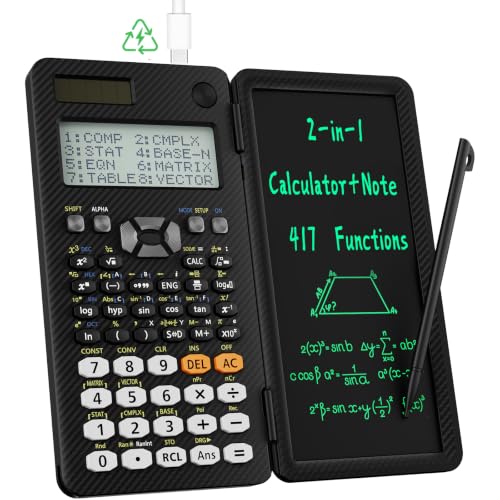
The ROATEE 991ES takes the scientific calculator format and adds something genuinely useful: a built-in LCD writing tablet on the other side. You get 417 functions covering algebra, geometry, statistics, calculus, matrix calculations, complex numbers, BASE-N conversions, equation solving, and more. And when you need to jot down an intermediate step or sketch a quick diagram, you flip to the notepad without reaching for a separate piece of paper.
The four-line display handles multiple calculations simultaneously in a natural textbook format. Functions are logically organized and the key layout will feel familiar to anyone who has used a Casio ES-series calculator before, since the ROATEE shares much of that layout. The buttons have a satisfying, clicky feedback that makes fast entry feel confident and accurate.
The notepad side uses a magnetic stylus that stores neatly in the body of the calculator. A lock-and-unlock switch prevents accidental erasure, which is a thoughtful detail that cheaper competitors with similar features miss entirely. The ABS body is rated for drop resistance, and at five ounces it slides easily into a bag without adding bulk.
The writing tablet is smaller than a full notepad, so it works best for quick scratch work rather than extended writing. That said, for capturing intermediate answers and working through multi-step problems, it earns its place.
Key Specs:
- Display: 4-line LCD, 6.2 cm screen
- Functions: 417
- Power: Battery powered (CR5 included)
- Dimensions: 6.32″ L x 3.28″ W
- Includes: LCD writing tablet, magnetic stylus, protective case
- Body material: ABS with anti-drop design
- Built-in lockable LCD notepad is a practical addition for study and exam prep
- 417 functions cover a broader range than most competitors in this category
- Lock-and-unlock switch prevents accidental erasure of notes
- Solid drop-resistant build at a portable weight
- Writing tablet area is small, limiting it to short notes and scratch work
- Battery only, no solar option
Best Calculators for LET Exam: A Quick Rundown
- HP Prime G2 — Best for test-takers who want maximum computing power and advanced graphing capability
- Texas Instruments TI-30XS MultiView — Best all-around pick for exam compliance, reliability, and ease of use
- Casio fx-115ES Plus 2nd Edition — Best for function depth at a mid-range price
- Casio fx-300MS Plus 2nd Edition — Best budget pick for clean, no-fuss exam use
- ROATEE 991ES with Notepad — Best for students who want a calculator and scratch pad in one device
Final Thoughts
Choosing the right calculator for the LET exam comes down to three things: what functions you actually need, how quickly you can operate the device under pressure, and whether it will be allowed in the exam room. A calculator that feels comfortable in your hand after weeks of practice is worth more than a feature-heavy model you never fully figured out.
Whatever you pick, spend real time with it before exam day. Learn the shortcuts. Practice the key sequences. The calculator that helps you most is the one you trust completely when it matters.