Picking the right calculator for a statistics class feels like a small decision until you’re midway through an exam and realize yours can’t handle standard deviation or regression. The wrong tool slows you down, and the right one can genuinely make tricky concepts click. That’s a difference worth caring about before you spend a dollar.
This guide covers five of the most reliable scientific calculators available right now for students taking elementary statistics. We tested and researched each one with a focus on what actually matters in a stats course: ease of use, display clarity, statistical function depth, and value for the price.
By the time you finish reading, you’ll know exactly which calculator fits your situation, whether you’re just getting started with descriptive stats or pushing through regression analysis and probability distributions.
How We Selected the Best Calculators for Elementary Statistics
Our team spent time evaluating dozens of scientific calculators before narrowing down to these five picks. We focused on real-world usability in a statistics course context, not just spec sheets. Every calculator on this list was chosen because it genuinely helps students do the work, not just because it looks impressive on paper.
Here are the factors that guided our selection:
- Statistical function coverage: We prioritized calculators that handle one- and two-variable statistics, standard deviation, regression analysis, and probability calculations without burying those functions in hard-to-find menus.
- Display readability: A clear, well-lit display reduces mistakes during timed exams. We looked at line count, contrast, and whether equations appear in natural textbook format.
- Ease of use: First-time scientific calculator users shouldn’t need hours of tutorial videos just to find the stats menu. Intuitive layouts matter.
- Exam approval: Many instructors and institutions restrict graphing calculators. We confirmed that every pick here is a non-graphing scientific calculator appropriate for most statistics courses and standardized tests.
- Build quality and portability: Calculators that survive a semester in a backpack without failing are worth more than fragile ones with fancy specs.
- Power reliability: Solar-plus-battery setups are ideal for students who don’t want to worry about dead batteries during an exam.
- Value for money: Every pick offers solid capability at a price that doesn’t punish a student budget.
Each calculator on this list holds up well across all of these dimensions. The differences between them come down to depth of features and who they’re best suited for, which you’ll see clearly in the reviews ahead.
Best Calculators for Elementary Statistics (Expert Ranking & Review)
The five calculators below represent a strong range of options for statistics students at every level. Whether you need something simple and affordable or a machine loaded with advanced functions, there’s a solid pick here for you.
1. Casio fx-991CW: The Most Capable Non-Graphing Calculator You Can Buy

The Casio fx-991CW sits at the top of this list for one straightforward reason: it delivers more capability than any other non-graphing calculator at anywhere near its price. With over 540 functions, it covers everything an elementary statistics course demands and then some. When you outgrow intro stats and move into more advanced coursework, this calculator moves with you.
The display on this model is a standout. Its high-resolution, 4-tone LCD lets you see equations in natural textbook format, which means fractions look like fractions and square roots look like square roots. That kind of visual accuracy cuts down on input errors, especially during fast-paced exams. We found it noticeably easier to cross-check work on this screen compared to standard 2-line displays.
Where the fx-991CW really pulls ahead is in its statistical firepower. It handles data lists in a spreadsheet-style view, supports 4×4 matrix operations, numeric differentiation and integration, and gives you access to 47 scientific constants and 40 unit conversions through its Math Catalog. For a statistics course, the one- and two-variable stats modes are clean and accessible once you spend a few minutes with the menus.
One thing worth knowing: the menu-driven interface takes some getting used to. This calculator leans heavily on screen navigation rather than dedicated shortcut keys, and a small number of users initially find that less intuitive than button-heavy layouts. That said, once you learn the layout, the speed and power are hard to argue with. A QR code feature even lets you visualize graphs on ClassPad.net using your phone, which is a clever workaround for the no-graphing-calculator rule.
Key Specs:
- Functions: 540+
- Display: High-resolution 4-tone LCD, Natural Textbook Display
- Power: Solar with LR44 battery backup
- Dimensions: 6.3″ x 3″
- Weight: 3.35 oz
- Unmatched function count for a non-graphing calculator
- Natural textbook display with excellent screen clarity
- QR code graphing via ClassPad.net
- Spreadsheet-style data viewing for stat work
- Menu-heavy interface has a learning curve
- Some users prefer more dedicated shortcut buttons
2. Texas Instruments TI-30XS MultiView: The Exam-Ready Workhorse

If you need a calculator that’s approved for the SAT, ACT, PSAT, MCAT, and a long list of professional licensing exams, the TI-30XS MultiView is the one to know. It’s the go-to recommendation for students who want a machine that travels well from math class to high-stakes testing without any second-guessing at the exam room door.
The four-line display is the biggest practical advantage here. You can enter multiple calculations, compare results, and scroll back through your work, all on a single screen. The MathPrint mode shows stacked fractions, exact square roots, and exponents exactly as they’d appear in a textbook. For statistics students checking their steps or spotting patterns in data, that visibility is genuinely useful.
The TI-30XS handles one- and two-variable statistics cleanly, with a toggle key that lets you flip between fractions and decimals in a single press. The x/y table function is particularly handy for exploring function values, and the edit-cut-paste feature lets you reuse and modify previous entries without retyping from scratch.
Build quality on this calculator is reassuring. We’ve seen reports of units lasting well over a decade with regular use. The face cover snaps off and stores on the back of the unit, which is a smart design detail that keeps the calculator protected without adding extra pieces to lose. Dual solar and battery power means you’re unlikely to ever run out of juice at a critical moment.
Key Specs:
- Display: 4-line LCD, 16 characters per line, MathPrint mode
- Power: Solar and CR2032 battery
- Dimensions: 7.25″ x 3.38″
- Weight: 0.51 lb
- Approved for SAT, ACT, MCAT, and professional licensing exams
- Four-line display with MathPrint for textbook-style entry
- Durable, with decades of proven reliability
- One- and two-variable statistics built in
- Fewer advanced functions than the Casio fx-991CW
- Changing the battery requires unscrewing the back panel
3. Casio fx-115ES Plus 2nd Edition: A Power-Packed Option at a Friendly Price

The Casio fx-115ES Plus 2nd Edition earns its reputation as one of the best values in scientific calculators. At its price, the function list is hard to believe: over 280 capabilities that include complex number calculations, linear regression, summation, integration, permutations and combinations, and matrix and vector operations. For a statistics student, that’s every tool you’ll need for intro stats and a few beyond.
What makes this calculator particularly strong for a statistics course is how naturally it handles regression and data analysis. The Natural Textbook Display puts fractions, roots, and multi-step expressions in a format that matches your textbook, so you spend less time translating what you see on the screen and more time actually working the problem. A Multi-Replay function lets you backtrack through calculations step by step, which is invaluable when you’re tracking down a mistake.
The build feels solid for its size. The calculator is light and compact enough to fit in a backpack pocket, but it doesn’t feel flimsy. Solar Plus power with a battery backup means you’re not going to find yourself stranded mid-exam. One practical note: the white color variant picks up grime with daily use, so the non-white versions tend to stay looking cleaner over a semester.
We found the fx-115ES Plus exceptionally well-suited for students in statistics, pre-calculus, and calculus courses simultaneously, since it handles all three without needing a separate machine. The equation solver and simultaneous equation solver are particularly handy for coursework that crosses into algebra and physics. If you want broad coverage at a price that doesn’t stretch your budget, this is your pick.
Key Specs:
- Functions: 280+
- Display: 16-digit, 4-line Natural Textbook Display
- Screen Size: 6.5 cm
- Power: Solar Plus with LR44 battery backup
- Dimensions: 9″ x 5.5″
- 280+ functions covering stats, calculus, matrix, and more
- Natural Textbook Display with Multi-Replay for error checking
- Solar Plus power with battery backup
- Approved for a wide range of academic and professional exams
- No quick toggle for scientific notation display
- Light color option shows dirt easily
4. Casio fx-300ES Plus 2nd Edition: The Smart Pick for Stats Beginners
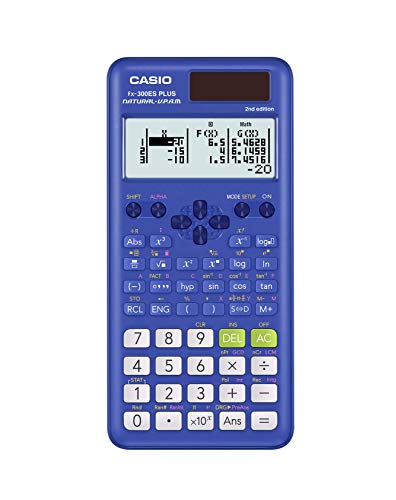
For students who are new to scientific calculators and taking their first statistics course, the Casio fx-300ES Plus 2nd Edition hits a sweet spot that more advanced models sometimes miss: it gives you everything you actually need without overwhelming you with things you don’t. The 262 built-in functions cover general math, statistics, regression analysis, trigonometry, and fractions without turning the keypad into a puzzle.
The Natural Textbook Display is the centerpiece feature here. Entering equations that look exactly like what’s written in your textbook reduces a surprising amount of cognitive friction when you’re already concentrating on the math itself. The two-function table lets you calculate f(x) and g(x) values with defined steps, which comes in handy when exploring statistical relationships and patterns.
At roughly 3.7 ounces, this is one of the lighter options on this list. It fits easily into any backpack pocket, and the protective sliding cover keeps the keys safe during transport. Solar Plus technology with a battery backup means power is a complete non-issue. There’s no charging port to forget, no low-battery warning to catch you off guard. It just works.
The one limitation to know going in is that this model has a 2-line display rather than the full 4-line setup found on some of the other picks here. You see your expression on one line and the result on the other. It’s clear and readable, but you won’t get the multi-line scrolling view that more advanced models offer. For an intro stats class, that’s rarely a problem.
Key Specs:
- Functions: 262
- Display: 2-line Natural Textbook Display
- Screen Size: 6.25 cm
- Power: Solar Plus with LR44 battery backup
- Dimensions: 6.4″ x 3.1″
- Natural Textbook Display makes equation entry intuitive
- Lightweight and compact with a protective sliding cover
- Solar Plus power with no charging required
- Covers all the stats functions needed for intro coursework
- 2-line display limits multi-step equation visibility
- No simultaneous equation solver or matrix operations
5. Casio fx-300MS Plus 2nd Edition: The No-Fuss Budget Pick That Still Delivers

Sometimes you just need a dependable, no-drama calculator that handles your statistics homework, costs as little as possible, and doesn’t require a tutorial to figure out. The Casio fx-300MS Plus 2nd Edition is that calculator. It’s straightforward, sturdy, and covers the statistical functions that matter most in an introductory course.
The 2-line, 10-digit LCD display is clear and highly legible, with users specifically noting how readable it is in a wide range of lighting conditions, including outdoor use. Bold contrast and a well-chosen font size make the numbers easy to read even at a slight angle, which is a practical advantage during a lab or an in-person exam. Statistical functions include two-variable statistics, standard deviation, and regression analysis, covering the core needs of most elementary statistics courses.
This model supports up to 9 variable memories plus last-answer recall, and you can convert between improper fractions, mixed numbers, and decimals with a dedicated fraction key. The hard protective case keeps the calculator safe during daily transport, and the slim, light body (just 0.3 lb) means it barely takes up room in your bag.
What you give up at this price point is depth. There’s no natural textbook display, no multi-line expression entry, and no advanced functions like integration or matrix operations. But for a student whose stats course sticks to descriptive statistics, probability basics, and regression fundamentals, none of that is missing. The fx-300MS Plus is also approved for AP, SAT, PSAT/NMSQT, and ACT exams, which adds real value for students who use it across multiple subjects and test situations.
Key Specs:
- Display: 2-line, 10-digit LCD
- Screen Size: 3 inches
- Power: Solar with LR44 battery backup
- Compatible Devices: AP, SAT, PSAT/NMSQT, ACT testing
- Dimensions: 6.4″ x 3″
- Highly readable display with excellent contrast
- Covers two-variable stats, standard deviation, and regression
- Approved for AP, SAT, PSAT, and ACT exams
- Lightweight and affordable
- No natural textbook display
- Limited to basic-to-intermediate statistical functions
Best Calculators for Elementary Statistics: A Quick Rundown
- Casio fx-991CW: Best overall, with the most advanced feature set of any non-graphing calculator on this list.
- Texas Instruments TI-30XS MultiView: Best for exam versatility, approved for the widest range of standardized and professional tests.
- Casio fx-115ES Plus 2nd Edition: Best value for advanced users who need stats, calculus, and matrix functions in one affordable package.
- Casio fx-300ES Plus 2nd Edition: Best for beginners, with a clean natural display and everything an intro stats student needs without the clutter.
- Casio fx-300MS Plus 2nd Edition: Best budget pick, combining solid statistical capability with a low price and excellent display readability.
Final Thoughts
Choosing a calculator for elementary statistics comes down to knowing what level of support you actually need. A student in a one-semester intro course has very different requirements from someone who will carry the same calculator through multiple years of STEM coursework. Matching the tool to the task is how you get real value from your purchase.
Whatever you choose, prioritize a clear display, solid statistical function coverage, and exam compatibility for your specific course or institution. The right calculator won’t do the math for you, but it will absolutely stop getting in the way of you doing it. Pick based on your actual workload, your budget, and how long you need it to last, and you’ll make a decision you won’t regret.