Nursing school is no joke. Between pharmacology, dosage calculations, and the sheer volume of math you need to get right under pressure, having the wrong calculator can slow you down at exactly the wrong moment. Whether you are crunching IV drip rates in a lab setting or working through statistics homework at midnight, the calculator in your bag needs to keep up.
The problem is that the calculator market is flooded with options, and most buyers end up guessing. Some picks are overkill for nursing coursework. Others fall short when the math gets more complex. This guide cuts through all of that.
We tested and researched the five calculators below specifically with nursing students and working nurses in mind. Every pick was evaluated on reliability, ease of use, display clarity, and how well it handles the types of math nursing actually demands. Here is what we found.
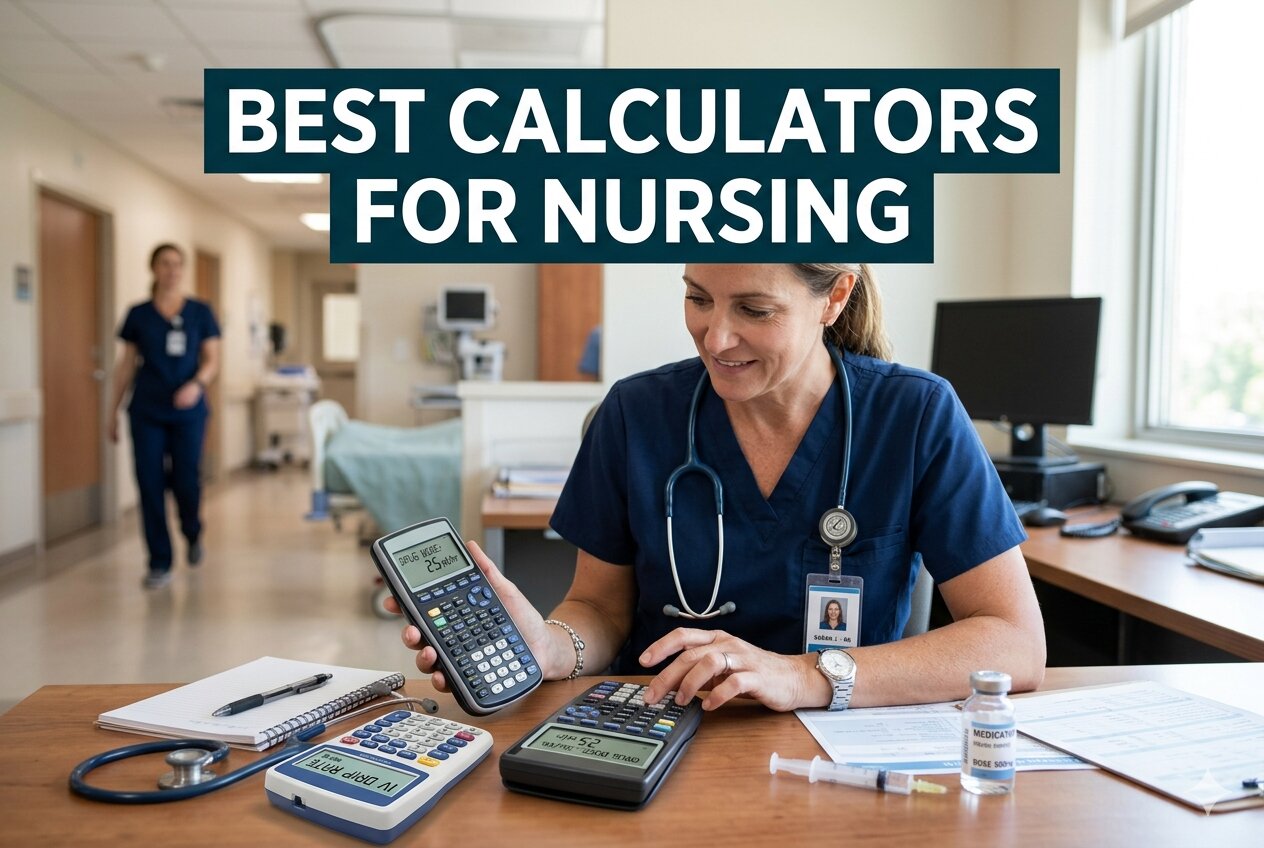 How We Selected the Best Calculators for Nursing
Our team spent time evaluating dozens of calculators before narrowing the list to these five. We focused on real-world usability for nursing students and professionals, not just spec sheets. The goal was to find calculators that perform when it counts.
Here are the factors we weighed most heavily:
- Display clarity: A screen you can actually read under exam lighting or in a dimly lit clinical setting is non-negotiable.
- Function range: Nursing math covers everything from basic arithmetic to statistics and fractions. We looked for calculators that cover that full spectrum.
- Portability: Nurses are always on the move. Size and weight matter.
- Durability: A calculator that falls apart after one semester is not worth your money.
- Power reliability: Solar backup, battery life, and dual-power options all factor into whether a calculator will be ready when you need it.
- Ease of use: Menus that take a manual to figure out are frustrating under pressure. Intuitive layout was a key consideration.
- Value for money: We looked for tools that deliver strong performance without unnecessary expense.
Every product on this list earned its spot by performing well across most of these criteria. The reviews ahead will help you figure out which one fits your specific situation best.
Best Calculators for Nursing (Expert Ranking & Review)
The five calculators below span a wide range of price points and feature sets. Whether you are just starting nursing school or looking for a reliable daily carry for clinical work, there is a strong option here for you.
1. Casio fx-115ES Plus 2nd Edition: The Powerhouse Pick for Nursing Students Tackling Advanced Math

The Casio fx-115ES Plus 2nd Edition is the top pick on this list for good reason. It covers more than 280 functions, including complex number calculations, linear regression, matrix operations, permutations, and integration. For nursing students in advanced coursework, that depth of capability means you will rarely, if ever, hit a wall.
What really sets this calculator apart is the Natural Textbook Display. Fractions, roots, and equations appear on screen exactly the way they look in your textbook. That makes it far easier to verify your work at a glance and reduces the chance of misreading a result under pressure.
We were particularly impressed by the Multi-Replay function, which lets you backtrack through your calculation history, edit expressions, and recalculate step by step. For dosage and pharmacology work where a single input error can change everything, that kind of error-checking capability is genuinely useful.
Power is covered with Solar Plus technology and a battery backup, so you are not scrambling for fresh batteries the morning of an exam. The 16-digit, 4-line LCD gives you enough screen real estate to track what you are doing without losing your place.
Key Specs:
- Functions: 280+
- Display: 16-digit, 4-line LCD with Natural Textbook Display
- Power: Solar Plus with battery backup
- Calculator type: Scientific
- Screen size: 6.5 cm
- Natural Textbook Display makes reading formulas straightforward
- Multi-Replay function catches input errors before they cost you
- Handles statistics, calculus, and matrix math in one device
- Display contrast can be tricky in low-light environments
- Takes time to learn the full function library
2. Mr. Pen Scientific 2 Line Calculator: The Budget-Friendly Scientific Option That Gets the Job Done
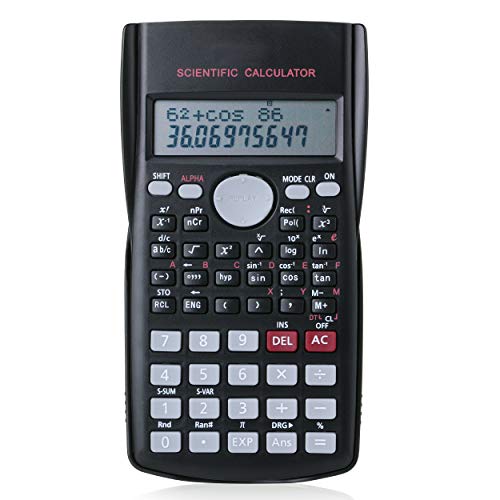
If you want scientific calculator capability without the premium price tag, the Mr. Pen Scientific 2 Line Calculator delivers a solid package. With 240 scientific functions and a widescreen 10+2 digit HD display, it covers the core math needs of most nursing programs comfortably.
The 2-line display is a genuine convenience. You see both your input and your result at the same time, which means less second-guessing and fewer re-entries. For students working through fraction-heavy pharmacology problems, that visibility matters more than most people realize before they actually sit down to use one.
It comes with a protective hardcover that keeps the keys and screen safe during the daily grind of nursing school. Tossed in a bag between classes, it holds up reasonably well. The ergonomic design makes it comfortable to hold during longer study sessions.
Key Specs:
- Functions: 240 scientific functions
- Display: 10+2 digit, 2-line widescreen HD
- Power: Battery powered
- Size: 6 x 3.3 x 0.6 inches
- Includes: Protective hardcover
- 2-line display shows entry and result simultaneously
- Very affordable for the function count it offers
- Protective hardcover adds everyday durability
- Battery-only power means you need to keep spares handy
- Some units have reported inconsistent display viewing angles
3. Casio fx-300MS Plus 2nd Edition: The Reliable Mid-Range Pick for Core Nursing Math

The Casio fx-300MS Plus 2nd Edition is the kind of calculator that just works, every single time. It covers trigonometric and hyperbolic functions, factorials, logarithms, statistics, standard deviation, regression analysis, and fraction conversion. That covers essentially everything a nursing student will encounter outside of the most advanced math electives.
The 2-line, 10-digit LCD shows your expression and result together, which keeps your workflow moving without constant back-checking. The display is notably bold and high-contrast, making it easier to read in varied lighting. That is a real advantage in lecture halls with inconsistent overhead lighting or during outdoor study sessions.
It runs on solar power with a battery backup, and it comes with a hard protective case for storage and transport. The slim profile fits easily into a pencil case or coat pocket. We found the key spacing comfortable and the layout intuitive enough that most users get up to speed without spending much time with the manual.
One thing worth knowing: it stores up to 9 variables plus last-answer recall, which is handy for multi-step calculations common in nursing dosage problems.
Key Specs:
- Display: 2-line, 10-digit LCD
- Power: Solar with battery backup
- Variable memory: 9 variables plus last-answer recall
- Calculator type: Scientific
- Includes: Hard protective case
- Bold, high-contrast display reads well in any lighting
- Covers trig, stats, fractions, and regression
- Hard protective case included
- Solar plus battery power for uninterrupted use
- Fewer advanced functions than the fx-115ES Plus
4. Casio SL-310SV: The Slim, Carry-Anywhere Option for Quick Clinical Calculations

Not every nursing calculation requires a full scientific calculator. For quick arithmetic on the floor or at the bedside, the Casio SL-310SV is the one to reach for. It is a 10-digit pocket calculator with a metal faceplate, a wallet-style case, and solar power with battery backup. It fits easily in a uniform pocket or the front sleeve of a nursing bag.
The large 10-digit LCD is clear and easy to read, with numbers that are sharp and well-spaced. It includes a square root key, percentage function, and auto power-off after ten minutes of inactivity to conserve battery. Simple, practical features that are exactly what you need when you are in the middle of a shift and need a fast answer.
The metal faceplate gives it a more durable feel than standard plastic calculators at this price point. Some users have noted the faceplate is thin, and it can flex under heavy pressure, but for normal daily use it holds up just fine. The wallet-style case protects both the screen and keys during transport.
Key Specs:
- Display: Large 10-digit LCD
- Power: Solar with battery backup
- Auto power-off: 10 minutes
- Faceplate: Metal
- Includes: Wallet-style case
- Ultra-portable form factor fits in uniform pockets
- Clear, large 10-digit display
- Metal faceplate adds a layer of protection
- Basic functions only, no scientific capability
- Metal faceplate can flex under heavy pressure
5. Casio HS-8VA Mini 6-Function Calculator: The Ultra-Compact Backup That Earns Its Place

Every nurse should have a small, no-fuss calculator somewhere close at hand, and the Casio HS-8VA is about as practical as it gets for that role. At just 4 x 2.25 x 0.3 inches and 1.23 oz, it disappears into a pocket or a badge holder slot. The 8-digit LCD is clear and easy to read despite the compact frame.
It handles the six basic functions nursing calls for most often in clinical settings: addition, subtraction, multiplication, division, percentage, and square root. The memory keys (M+, M-, Memory Clear, and +/-) allow for efficient multi-step calculations without having to re-enter partial results. That is more useful than it sounds when you are trying to quickly verify a medication dose between tasks.
Solar powered with battery backup, it runs on essentially nothing and stays ready. We found the buttons responsive and tactile, which helps when you are entering numbers quickly and cannot afford to second-guess whether a keypress registered. Some users with larger hands may find the keys small, but as a backup or supplemental tool it is hard to beat at this size and price.
Key Specs:
- Display: 8-digit LCD
- Dimensions: 4 x 2.25 x 0.3 inches
- Weight: 1.23 oz
- Power: Solar with battery backup
- Functions: 6 standard functions with memory keys
- Genuinely pocketable size and weight
- Responsive, tactile buttons
- Solar plus battery power means it is always ready
- 8-digit display with no scientific functions
- Keys may feel cramped for users with larger hands
Best Calculators for Nursing: A Quick Rundown
- Casio fx-115ES Plus 2nd Edition: Best overall for nursing students in advanced coursework, with 280+ functions and Natural Textbook Display
- Mr. Pen Scientific 2 Line Calculator: Best budget scientific calculator, solid function range at a very low price
- Casio fx-300MS Plus 2nd Edition: Best mid-range pick for core nursing math with a high-contrast display and protective case
- Casio SL-310SV: Best slim carry-anywhere option for quick clinical arithmetic
- Casio HS-8VA: Best ultra-compact backup calculator for on-the-floor use
Final Thoughts
Choosing the right calculator for nursing comes down to where you are in your training and what you actually need it for. Students in pharmacology, statistics, or advanced science courses will get the most out of a full scientific calculator with a multi-line display and a strong function library. Nurses working in clinical settings, on the other hand, often just need something fast, reliable, and small enough to slip into a pocket.
Whatever your situation, prioritize display clarity, ease of use, and power reliability above all else. A calculator that is hard to read or unpredictable under pressure is not doing you any favors. Pick the one that fits your daily reality, and it will pay for itself many times over.