Land surveying demands precision at every step. Whether you’re computing traverse closures, converting between coordinate systems, or estimating material volumes for a boundary project, the calculator in your pocket has a real job to do. A weak tool slows you down, introduces errors, and costs you credibility on the job.
This guide cuts through the noise and focuses on five calculators that genuinely earn their place in a surveyor’s kit. We looked at scientific capability, ease of use in the field, build quality, and overall value for the work surveyors actually do. By the time you finish reading, you’ll know exactly which one fits your workflow.
The picks below range from purpose-built construction math tools to high-function scientific calculators that can handle the trig-heavy demands of survey fieldwork. There’s something here for every budget and skill level.
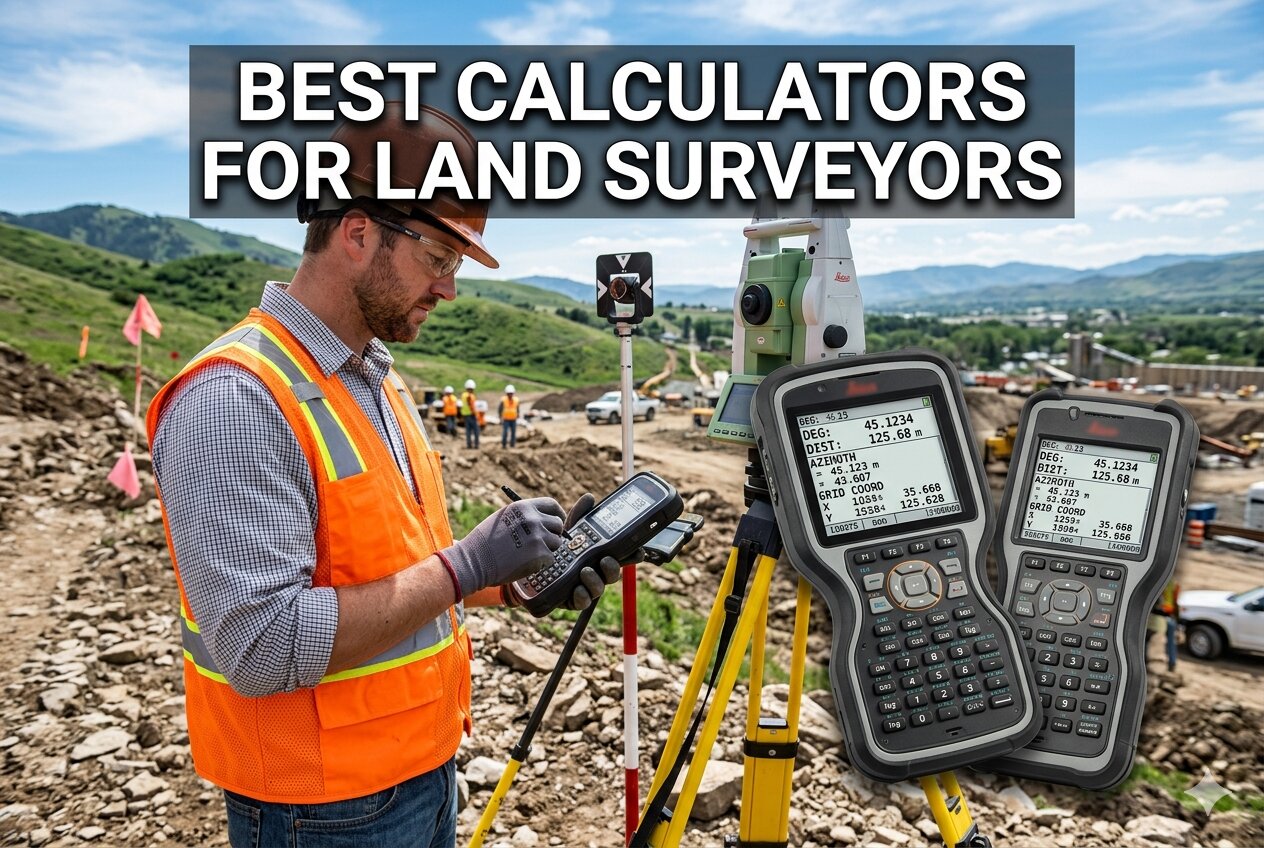 How We Selected the Best Calculators for Land Surveyors
Our team evaluated dozens of options before settling on these five. We focused on calculators that can realistically support the math surveyors encounter daily, from slope calculations and angle conversions to material estimates and coordinate work. Budget alone wasn’t the filter. Capability, reliability, and real-world usability all factored in.
Here’s what guided our picks:
- Trigonometric capability: Surveyors work with angles constantly. Any worthwhile calculator must handle sine, cosine, tangent, and their inverses without friction.
- Unit flexibility: The ability to work in degrees, minutes, and seconds, plus convert between decimal degrees and DMS, is essential for fieldwork accuracy.
- Display clarity: A screen you can actually read in bright sunlight or low-light conditions matters more than most buyers realize until they’re in the field.
- Dimensional math support: Working natively in feet, inches, and fractions saves time and reduces conversion errors during layout and estimation tasks.
- Power reliability: Battery life and solar backup options affect whether your calculator keeps working during a long day outdoors.
- Durability and portability: A calculator that can’t survive a tool bag or a rough job site isn’t worth carrying.
- Function depth: Beyond basic math, surveyors benefit from calculators that handle complex equations, matrix operations, and statistical functions for more advanced work.
Every product here was evaluated against these standards. The lineup isn’t perfect for every surveyor, but each one earns its spot for specific reasons. Here’s what we found.
Best Calculators for Land Surveyors (Expert Ranking & Review)
These five calculators cover the full spectrum of what surveyors need, from dedicated construction math tools to advanced scientific workhorses. Read through each review to find the one that matches your day-to-day demands.
1. Calculated Industries 4065 Construction Master Pro: The Surveyor’s Field Workhorse

If there’s one calculator that’s earned a reputation across the trades, it’s the Construction Master Pro. Calculated Industries has been refining this tool for over 30 years, and the result is a calculator that just works the way field professionals think. It’s not a general-purpose scientific calculator. It’s built for dimensional math, and it does that job better than anything else on this list.
For land surveyors, the real value is in how the CM Pro handles unit conversions. You can enter measurements directly in feet-inch-fractions, decimal feet, yards, or metric and convert between them instantly. That kind of fluency matters when you’re bouncing between a legacy survey drawing in feet and fractions and a modern CAD file in decimal feet. The pitch key also gives you fast slope and grade solutions without manual trig entry.
The physical build is compact at 5.75 by 3 inches and weighs just 0.51 pounds. It ships with an Armadillo Gear protective cover, which is a meaningful addition for anyone working on active job sites. The auto shut-off kicks in after 8 to 12 minutes of inactivity, and the paperless tape lets you review the last 20 entries to catch any input errors.
We found the right-angle and rafter functions particularly useful for surveyors doing site layout. Square-up calculations, rake-wall setups, and stair layouts all resolve quickly using dedicated keys, which removes the need to manually key in trig formulas. Four memory locations and a pocket reference guide round out a well-considered package.
Key Specs:
- Calculator Type: Construction/Building
- Power Source: Battery (2 LR44 batteries included)
- Screen Size: 2.6 inches LCD
- Dimensions: 5.75″L x 3″W
- Weight: 0.51 lbs
- Warranty: 1-year manufacturer
- Works natively in feet-inch-fractions, decimal feet, yards, and metric with instant conversion
- Dedicated right-angle, pitch, and slope functions eliminate manual trig entry
- Ships with a protective Armadillo Gear cover and pocket reference guide
- No trigonometric function keys (sine, cosine, tangent) for advanced angular calculations
- Limited to construction math use cases; not suitable for scientific or engineering coursework
2. Casio fx-115ES Plus 2nd Edition: The Scientific Standard for Trig-Heavy Survey Work

The Casio fx-115ES Plus 2nd Edition is the calculator you want when the math gets serious. With over 280 functions and a Natural Textbook Display that shows fractions, equations, and results exactly as they’d appear in a written formula, this is a tool that works with the way surveyors are trained to think. It handles everything from basic trig to complex number calculations, polar-to-rectangular conversions, and simultaneous equations.
Polar-rectangular conversion is worth calling out specifically for surveyors. Converting between polar coordinates (angle and distance) and rectangular coordinates (northing and easting) is a routine task in traverse work, and the Casio handles it without requiring you to manually apply the formulas. That alone can save meaningful time on projects involving multiple traverse legs.
Solar Plus power with a battery backup means you’re not hunting for batteries in the middle of a field session. The unit measures 9 by 5.5 inches and weighs just over 6 ounces, making it light enough to carry without thinking about it. The multi-replay function lets you backtrack through calculations and edit expressions step by step, which is genuinely useful when you need to trace an error in a chain of survey computations.
We tested the simultaneous equation solver and found it dependable for two- and three-variable systems, which applies directly to coordinate geometry problems surveyors encounter. The display is a 16-digit, 4-line LCD. It won’t win awards for outdoor brightness, but in most working conditions it’s clear and readable.
Key Specs:
- Calculator Type: Engineering/Scientific
- Power Source: Solar Plus with battery backup (1 LR44 included)
- Display: 16-digit, 4-line LCD
- Functions: 280+
- Dimensions: 9″L x 5.5″W
- Weight: 6.05 oz
- Polar-to-rectangular conversion built in, essential for traverse coordinate work
- Natural Textbook Display shows equations as written, reducing input errors
- Solar Plus power with battery backup for uninterrupted field use
- Multi-replay lets you backtrack and edit calculation chains
- Display can be difficult to read in very bright outdoor light
3. Calculated Industries 4019 Material Estimator: The Estimation Specialist Surveyors Overlook

The Material Estimator doesn’t get talked about in surveying circles as much as it should. Most people think of it as a contractor’s tool, which it is, but surveyors involved in site development, boundary work with construction tie-ins, or quantity estimation for land improvement projects will find it genuinely useful. It handles linear, area, and volume calculations natively in feet, inches, fractions, yards, and meters with no decimal conversion required.
Where this calculator earns its keep is in the estimating functions. You can store material specifications like fence post spacing, custom tile sizes, or board widths, then instantly calculate quantities based on a measured area or length. For a surveyor helping a client understand what a parcel of land can accommodate, or one involved in pre-construction layout, that’s a tangible time saver.
The unit measures 5.75 by 3.25 inches and weighs half a pound. It runs on dual power, solar and battery, and comes with a hard-cover protective door that doubles as a quick reference guide holder. The yellow casing is a practical touch. It’s hard to lose a yellow calculator on a job site. Concrete bag counts, gravel volumes, paint coverage, and board feet are all handled through dedicated keys rather than manual formulas.
Key Specs:
- Calculator Type: Engineering/Scientific (Construction-focused)
- Power Source: Dual (Solar + Battery CR2016 included)
- Dimensions: 5.75″L x 3.25″W
- Weight: 0.5 lbs
- Display: LCD
- Warranty: 1-year limited
- Stores material specs and instantly calculates quantities from measured dimensions
- Works natively in feet, inches, fractions, yards, and metric without decimal conversion
- Dual solar and battery power; protective hard cover included
- No trigonometric functions; not suited for angular or coordinate calculations
- Maximum display capacity of 7 digits limits use on very large-scale cost calculations
4. ROATEE 991ES Scientific Calculator with Notepad: The Field-Note Combo That Saves Steps
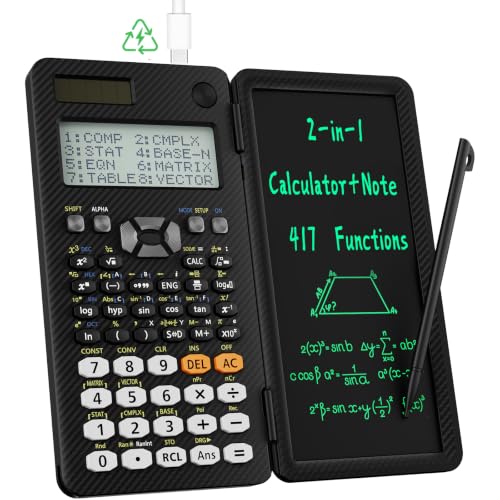
The ROATEE 991ES does something none of the other calculators on this list can do: it gives you a reusable notepad right next to the calculator. That sounds like a minor feature until you’ve spent time in the field juggling a clipboard, a calculator, and a pencil while trying to record traverse data or sketch a boundary description. The built-in LCD writing tablet with a magnetic stylus keeps your intermediate values and quick sketches right where you need them.
Under the hood, the 991ES packs 417 functions into a 4-line display that shows calculations in a natural textbook format. It handles trig, matrix calculations, vector operations, complex numbers, equation solving, and BASE-N conversions including binary, octal, and hexadecimal. For surveyors doing any amount of office-side coordinate geometry or supporting engineering teams, that function range covers a lot of ground.
The body measures 6.32 by 3.28 inches and weighs 5 ounces. It runs on a rechargeable coin battery and folds closed via a magnet, keeping the notepad protected and the stylus secure when the unit is in your bag. The lock/unlock switch for the writing tablet prevents accidental erasure, which we found to be a genuinely well-thought-out detail. Build quality is ABS plastic and feels solid for daily carry.
Key Specs:
- Calculator Type: Engineering/Scientific
- Power Source: Rechargeable coin battery (CR5 included)
- Display: 4-line LCD, 6.2 cm
- Functions: 417
- Dimensions: 6.32″L x 3.28″W
- Weight: 5 oz
- Built-in lockable LCD notepad with stylus for recording field values and sketches
- 417 functions cover trig, matrix, vector, complex numbers, and equation solving
- Rechargeable battery and magnetic fold-close design for durability and convenience
- Notepad writing area is relatively small; not suited for detailed sketches
- LCD writing tablet brightness can be low in certain lighting conditions
5. Sharp EL-W516TBSL Advanced Scientific Calculator: The Function-Dense Option for Detail-Oriented Surveyors

The Sharp EL-W516TBSL leads the field on raw function count. With 640 functions and 7 operating modes including Normal, Stat, Complex, Matrix, List, and Equation modes, this is the most capable scientific calculator in this lineup by a measurable margin. For surveyors who regularly move between statistical analysis, coordinate geometry, and complex field calculations, the breadth of tools here is hard to match at this price point.
The WriteView 4-line display shows expressions and results in textbook format, and the Home key is a feature we haven’t seen on the other picks. It lets you instantly return to Normal mode from any menu without cycling through multiple back presses. In a field setting where you might switch between modes frequently, that one button saves real time. The unit also supports up to 4×4 matrix calculations, which goes further than most non-graphing scientific calculators allow.
At 6.6 by 3.1 inches and just 0.24 ounces, it’s the lightest and most portable calculator in the lineup. Power comes from solar with a battery backup, and the slide-on cover protects the keys when the unit is packed away. Sharp also includes 8 temporary and 3 definable memory buttons, giving you more storage flexibility than the Casio or ROATEE options for users who want to keep frequently used constants or reference values at hand.
We did note that construction quality feels slightly less substantial than the Calculated Industries units. The buttons have a lighter feel, and users who carry their tools roughly may want to use the slide cover consistently. That said, the function depth here is genuinely impressive for a calculator at this price.
Key Specs:
- Calculator Type: Engineering/Scientific
- Power Source: Solar with battery backup
- Display: 16-digit, 4-line WriteView LCD
- Functions: 640
- Modes: 7 (Normal, Stat, Drill, Complex, Matrix, List, Equation)
- Dimensions: 6.6″L x 3.1″W
- 640 functions and 7 modes offer the deepest scientific capability in this lineup
- Home key returns to Normal mode instantly from any screen
- 8 temporary and 3 definable memory buttons for storing constants and reference values
- Build quality feels lighter than the Calculated Industries units
- Display can be hard to read in low-light conditions without a backlight
Best Calculators for Land Surveyors: A Quick Rundown
- Calculated Industries 4065 Construction Master Pro: Best for dimensional math and field layout; the top pick for surveyors doing site and boundary work with feet-inch-fraction measurements.
- Casio fx-115ES Plus 2nd Edition: Best for trig and coordinate calculations; ideal for surveyors who need polar-rectangular conversions and simultaneous equation solving.
- Calculated Industries 4019 Material Estimator: Best for quantity and material estimation; a strong companion for surveyors involved in pre-construction or land development projects.
- ROATEE 991ES Scientific Calculator with Notepad: Best for field note-taking combined with scientific calculation; a practical pick for surveyors who record data on the go.
- Sharp EL-W516TBSL: Best for function range; the top scientific option for detail-oriented surveyors who need the widest toolkit in a portable package.
Final Thoughts
Picking the right calculator for land surveying comes down to understanding where most of your work actually happens. If you spend the majority of your time doing field layout and dimensional conversions, a purpose-built construction math tool will serve you better than a general scientific calculator. If your work leans toward coordinate geometry, traverse closures, and trig-heavy analysis, you’ll want a scientific calculator with solid angular function support and preferably polar-to-rectangular conversion built in.
Think about portability, power reliability, and whether you need field note capability alongside your calculations. The best calculator for your kit is the one that fits your actual workflow, not the one with the most features on the box. Pick the tool that makes your daily math faster and more accurate, and it will pay for itself quickly.