Picking the wrong calculator for your GCSE Higher Maths exam is the kind of mistake that costs you marks before you’ve written a single answer. The right tool should feel like a natural extension of your brain, not a puzzle you have to solve mid-exam. That’s why what’s in your pencil case matters just as much as what’s in your head.
We put together this guide specifically for students sitting GCSE Higher Maths. The calculators featured here have been evaluated for exam compliance, ease of use under pressure, and the specific mathematical functions the Higher tier demands. You’ll walk away knowing exactly which one fits your needs.
Whether you’re just starting your revision or exam day is around the corner, this list gives you five solid options across a range of price points and feature sets. Each one has been assessed against what GCSE Higher actually tests.
 How We Selected the Best Calculators for GCSE Higher Maths
Our team spent time evaluating dozens of scientific calculators with a single question in mind: which ones genuinely serve a GCSE Higher student well, both in daily revision and in the exam hall? We cross-referenced specification lists against the AQA, Edexcel, and OCR Higher tier syllabuses, then looked at real-world usability factors that textbook specs don’t always capture.
Here’s what we weighed up:
- Exam approval status: A calculator that isn’t permitted in UK exams is no use at all. We only considered models that are approved for use in GCSE and equivalent qualifications.
- Natural Textbook Display: The Higher tier includes fractions, surds, and complex expressions. Calculators that display these as they appear in your textbook make input and checking significantly faster.
- Function coverage: Higher Maths demands trigonometry, statistics, standard form, powers, roots, and more. We checked that each model covers the full range without gaps.
- Display clarity: Under exam conditions, a hard-to-read screen costs time. We factored in display contrast, line count, and legibility from different angles.
- Power reliability: Running out of battery mid-exam is a disaster. Solar-assisted or dual-power models got extra credit here.
- Build and portability: The calculator needs to survive a school bag and stay functional across two years of use. We paid attention to button quality, protective casing, and overall durability.
- Value for money: Budget matters for students and parents alike. We made sure every pick justifies its place on this list relative to what it costs.
Every calculator on this list was selected because it earns its spot on its own merits. If it made this guide, it’s because we’d genuinely recommend it to a student sitting Higher Maths.
Best Calculators for GCSE Higher Maths (Expert Ranking & Review)
Below you’ll find five carefully chosen calculators, covering the range from budget-friendly basics to feature-packed study companions. Each one has been reviewed in detail so you can match the right model to how you work.
1. Casio fx-83GTCW: The UK’s Top Pick for GCSE Exam Day

The Casio fx-83GTCW is the upgraded successor to the fx-83GTX, which was already the best-selling scientific calculator in the UK. This newer version keeps everything that made the original great and improves on it in the ways that matter most for exam use, including a sharper high-definition display and a cleaner menu navigation system.
What makes this one stand out for GCSE Higher specifically is its approval status. It is permitted in every UK exam where a calculator is allowed, and it is formally recommended for Key Stages 3 and 4, covering GCSE, National, and Higher qualifications. That’s not a small thing. You don’t want to arrive at the exam hall with a calculator that gets confiscated.
The Natural Textbook Display is a genuine help when working through Higher Maths problems. Fractions appear as proper stacked fractions, roots look like roots, and results come out in a format that matches your working. That visual consistency between the calculator and your paper reduces errors. We found it especially useful when checking fraction arithmetic and handling recurring decimal conversions.
The calculator is powered by a single AAA battery and comes with a clip-on hard protective cover. It’s slim, lightweight, and easy to slip into any pencil case. For students who want a no-fuss, exam-ready calculator from a trusted brand, this is the most straightforward recommendation on the list.
Key Specs:
- Display: High-definition Natural Textbook Display (LCD)
- Power: Battery (1 x AAA)
- Exam approval: All UK exams, GCSE, National and Higher
- Dimensions: 6.38″ L x 3.03″ W
- Protective cover: Clip-on hard case included
- Officially approved and recommended for GCSE and equivalent UK qualifications
- Natural Textbook Display makes fraction and expression input clear and accurate
- Upgraded from the UK’s best-selling scientific calculator model
- Battery-only power (no solar backup)
2. Casio fx-115ES Plus 2nd Edition: The Power User’s Choice for Advanced Maths

If you want a scientific calculator that goes well beyond the basics, the Casio fx-115ES Plus 2nd Edition is a serious step up. It packs over 280 functions into a slim, solar-powered body, covering everything from basic trig all the way to matrix operations, summation, integration, and complex number calculations. For a Higher Maths student who also has physics, statistics, or further maths coursework, this calculator handles it all in one device.
The four-line, 16-digit LCD display is genuinely impressive for a handheld calculator at this price. You can see your full expression and the result simultaneously, and because it uses Natural Textbook Display, everything looks exactly as it would on a page. Fractions, roots, and exponents render cleanly. We found the Multi-Replay function particularly useful during revision: you can step back through a calculation, fix an error, and recalculate without retyping the whole thing from scratch.
This calculator runs on Solar Plus technology with a battery backup, which means it draws power from ambient light and only taps the battery when the room is dim. In practice, the battery lasts an extremely long time, and you’re very unlikely to run flat during an exam. That peace of mind is worth something.
It’s worth noting that the display, while rich with information, uses smaller characters than some simpler models. Students with any visual strain may want to test it before committing. That’s a minor trade-off for the sheer depth of functionality it offers.
Key Specs:
- Display: 4-line, 16-digit Natural Textbook Display (LCD)
- Functions: 280+
- Power: Solar Plus with battery backup (1 x LR44 included)
- Dimensions: 9″ L x 5.5″ W
- Screen size: 6.5 cm
- 280+ functions covers the full GCSE Higher spec and well beyond
- Solar Plus power means near-zero risk of running out during exams
- Multi-Replay function makes error-checking fast and efficient
- Four-line display lets you see expressions and results at the same time
- Display characters are smaller and lower-contrast than simpler models
- Larger physical footprint than other calculators on this list
3. Casio fx-300ES Plus 2nd Edition: The Reliable All-Rounder at a Great Price
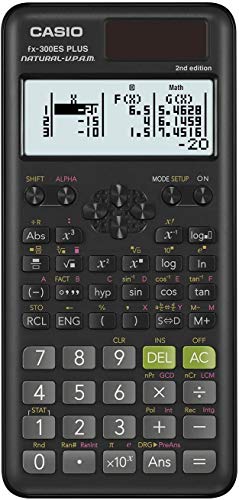
The Casio fx-300ES Plus 2nd Edition is built for exactly the kind of maths that fills a GCSE Higher paper. It covers 262 functions, including trigonometry, statistics, regression analysis, exponential calculations, and fractions, which maps closely to what the Higher tier actually tests. This isn’t a calculator that overpromises. It does what you need it to do, consistently.
The slide-on hard case is a practical feature that students tend to underrate. It protects the buttons during transport, and the inside of the case includes a helpful reference guide for mode changes and fraction conversions. That’s genuinely useful during the early weeks of learning the device. The build is compact, lightweight at 3.68 ounces, and sits easily in a pencil case without adding bulk.
One feature we particularly appreciated is the two-function table. You can compute tables of values for f(x) and g(x), set your own step size and range, and use it directly for graph-related questions on the Higher paper. Combined with the ability to generate random numbers and convert between fractions and decimals on the fly, this calculator covers the Higher spec with room to spare.
Power comes from Solar Plus with battery backup, so you get the same reliability as pricier models. We found the Natural Textbook Display clear and easy to work with across all types of Higher Maths input.
Key Specs:
- Display: Natural Textbook Display (LCD), 6.5 cm screen
- Functions: 262
- Power: Solar Plus with battery backup (1 x LR44 included)
- Dimensions: 6.38″ L x 3.13″ W
- Weight: 3.68 oz
- 262 functions cover the full GCSE Higher specification
- Two-function table is directly useful for graph and values questions
- Solar Plus power with battery backup ensures exam-day reliability
- Two-line display only (one line for input, one for result)
- No advanced functions like matrix operations or integration
4. Casio fx-300MS Plus 2nd Edition: The Clear-Screen Companion for Trig and Stats

The Casio fx-300MS Plus 2nd Edition takes a different approach from the ES-series models. Instead of Natural Textbook Display, it uses a traditional two-line LCD that shows your expression on the top line and the result below. What it trades in visual elegance, it makes up for in raw legibility. The display has excellent contrast, and one reviewer who specifically compared it to other Casio models noted it is readable even in low-light conditions, which the ES-series can struggle with.
For GCSE Higher Maths, this calculator covers the core ground well. It handles trig, inverse and hyperbolic functions, factorials, logarithms, standard deviation, two-variable statistics, and regression analysis. It also stores up to nine variables plus last-answer recall, which is handy for multi-step problems where you’re carrying values forward.
The fraction key is particularly easy to use. You can switch between improper fractions, mixed numbers, and decimals quickly, without digging through menus. The calculator also supports probability simulations and works across degrees, radians, and grads, making it flexible for the full range of Higher content. It runs on solar power with a battery backup and comes with a protective hard case.
Build quality feels solid and purpose-built. The keys have a satisfying amount of physical feedback, and the spacing is comfortable for extended exam use. Students upgrading from a basic calculator will find the layout intuitive from the first day.
Key Specs:
- Display: 2-line, 10-digit LCD
- Screen size: 3 inches
- Functions: Trig, stats, fractions, logs, probability, regression
- Power: Solar with battery backup
- Storage: 9 variable memories plus last-answer recall
- Excellent display contrast, highly readable in varied lighting
- Fraction key makes fraction-decimal conversion fast and simple
- Comfortable, well-spaced keypad with good tactile feedback
- No Natural Textbook Display, expressions don’t render as they appear in textbooks
- Fewer total functions than other models on this list
5. Helect 2-Line Engineering Scientific Calculator: The Budget Option That Gets the Job Done

The Helect 2-Line Scientific Calculator is the most affordable pick on this list, and for students on a tight budget who need a functional scientific calculator fast, it delivers the basics without fuss. It handles 240 scientific functions, covers 1 and 2 variable statistics, works across degrees, radians, and grads, and supports scientific and engineering notation modes. For straightforward GCSE Higher calculations, it covers the essentials.
The 12-digit widescreen display shows inputs and results on two separate lines simultaneously. The HD screen is clear and easy to read when viewed from directly above, though at steeper angles the contrast drops noticeably. For desk use during revision, that’s rarely a problem. The body has an ergonomic shape with a comfortable grip, and the scratch-proof surface holds up well to daily bag-to-desk life. A sliding protective case covers both sides of the calculator.
It’s worth being upfront about one limitation we noted. Unlike Casio models, the Helect is not specifically listed as approved for use in UK GCSE exams. Most UK exam boards permit calculators that meet certain display and function restrictions rather than maintaining a named approved list, but students should verify their specific exam board’s policy before relying on this model in an official exam setting.
Where the Helect earns its place on this list is in the revision context. As a study calculator for working through past papers and building familiarity with scientific functions, it does a solid job at a price that makes it easy to replace if lost or damaged.
Key Specs:
- Display: 2-line HD LCD, 12 digits, 6.3 cm screen
- Functions: 240 scientific functions
- Power: Battery (1 x AA)
- Angle modes: Degrees, radians, grads
- Protective cover: Sliding hard case included
- Most affordable option on the list
- 240 functions covers core GCSE Higher content
- Solid build with a scratch-proof finish and sliding protective case
- No solar backup, relies entirely on a single AA battery
- UK exam board approval status not confirmed, verify before exam use
Best Calculators for GCSE Higher Maths: A Quick Rundown
- Casio fx-83GTCW: Best overall for GCSE exam day, officially UK-approved and exam-ready out of the box.
- Casio fx-115ES Plus 2nd Edition: Best for students who want maximum function coverage, including physics and statistics.
- Casio fx-300ES Plus 2nd Edition: Best all-rounder, strong function set with solar power at a mid-range price.
- Casio fx-300MS Plus 2nd Edition: Best for display clarity and readability, especially in varied lighting conditions.
- Helect 2-Line Scientific Calculator: Best budget pick for revision use, a capable entry-level option at the lowest price.
Final Thoughts
The single most important thing to check before buying any calculator for GCSE Higher Maths is exam approval. A calculator you can’t bring into the hall is money wasted. After that, focus on the functions that actually show up in your papers: trig, statistics, fractions, standard form, and powers. Any model on this list covers those. The differences come down to display quality, power source, and how far beyond the syllabus you want to reach.
Pick the calculator that matches your study habits, your budget, and the way you actually work through problems. The best one is the one you’ll use every day between now and exam day, and feel confident holding when the clock starts.