Picking the right calculator for GCSE Maths feels like a small decision until you’re sitting in an exam hall and your device isn’t doing what you need it to do. The wrong choice can slow you down, cost you marks, or worse, get you flagged for using a non-approved model. It matters more than most students realise.
This guide cuts through the noise. We looked at what GCSE Maths actually demands, from trigonometry and algebra to statistics and number work, and matched those demands against what each calculator can genuinely deliver. You won’t find vague praise here. Just straight, honest assessments of five calculators worth your attention.
Whether you’re shopping for yourself or picking one up for your child, you’ll walk away from this article knowing exactly which calculator fits your needs, your budget, and the exam room.
 How We Selected the Best Calculators for GCSE Maths
Our team spent time evaluating calculators across a range of criteria specific to GCSE Maths students. We looked at real-world usability, not just spec sheets, because a calculator that looks good on paper but confuses you mid-exam is no help at all.
Here are the factors that shaped our shortlist:
- Exam Approval: Whether the calculator is permitted in UK exams, including GCSE, is a non-negotiable starting point for any recommendation.
- Function Count and Relevance: We looked at which functions are actually useful for GCSE-level topics rather than just rewarding the highest number on a spec sheet.
- Natural Textbook Display: Seeing fractions, roots, and equations as they appear in a textbook reduces reading errors and speeds up checks.
- Ease of Use: A calculator with a steep learning curve is a liability in timed conditions. We valued clear labelling, logical layout, and intuitive key access.
- Display Quality: Legibility under different lighting conditions matters in exam halls where you can’t always control the environment.
- Build Quality and Durability: A calculator that survives daily school life needs solid construction, responsive buttons, and a protective case.
- Value for Money: We weighed what each calculator delivers relative to its price point, because not every student needs a premium model.
Every pick on this list cleared those criteria. You can trust that these aren’t filler recommendations added to make up numbers.
Best Calculators for GCSE Maths (2026 Expert Review)
Five calculators made our final cut, spanning a range of price points and capability levels. Each one has a clear reason to be here, and each review below gives you the detail you need to decide if it belongs in your school bag.
1. Casio fx-83GTCW: The Exam-Room Specialist Built for GCSE

When a calculator is described as the UK’s best-selling scientific calculator, that claim deserves scrutiny. After putting the Casio fx-83GTCW through its paces, we found the reputation is well earned. This is the upgraded successor to the widely trusted fx-83GT X, and it brings meaningful improvements including a high-definition display and improved menu navigation.
The standout credential here is straightforward: this calculator is approved for use in every UK exam where a calculator is permitted. It’s specifically recommended for Key Stages 3 and 4, covering GCSE, SQA National 4 and 5, and Higher qualifications. For a GCSE student, that approval removes any guesswork entirely.
The Natural Textbook Display shows roots, fractions, and expressions exactly as they appear in textbooks, which means what you write in your workings matches what you see on screen. That consistency reduces the chance of misreading your own results under pressure. The display is notably high-definition compared to the model it replaced.
The physical build is slim and lightweight, with a clip-on hard protective cover included. The layout is clean and the keys are clearly labelled. Students who have used older Casio models will find the transition to the CW series straightforward, and those picking up a scientific calculator for the first time will benefit from the logical organisation of functions.
Key Specs:
- Functions: Not specified (upgraded from fx-83GT X)
- Display: Natural Textbook Display, high-definition LCD
- Power: Battery (1 AAA)
- Protective cover: Clip-on hard case included
- Dimensions: 6.38″ x 3.03″
- Approved for every UK exam where calculators are allowed
- High-definition Natural Textbook Display
- Lightweight and slim with protective cover included
- Battery-only power (no solar backup)
- Higher price point compared to some alternatives on this list
2. Casio fx-991ES Plus 2nd Edition: The Power User’s Pick

If you want a scientific calculator that goes well beyond GCSE requirements without becoming confusing to use, the Casio fx-991ES Plus 2nd Edition is worth a serious look. It packs 417 functions into a compact body, covering everything from basic trig and statistics to integration, differentiation, matrices, complex numbers, and simultaneous equations. For a student with ambitions beyond GCSE, this is a calculator that won’t become obsolete after Year 11.
The Natural Textbook Display presents equations and results as you’d see them written out by hand or in a textbook. The 10-digit mantissa plus 2-digit exponential display gives you room to work with precision. We found the colour-coded keypad genuinely useful: it makes it quicker to identify the right key for the right function without hunting around.
Power comes from a combination of solar and battery, using a single LR44 cell as backup. That dual-power setup means you’re not going to be caught out by a dead battery on exam morning. The build quality is solid throughout, and the slide-on hard case adds a layer of protection that holds up well to daily bag life.
One thing worth knowing: this model is not a graphing calculator, which is fine for GCSE purposes but worth understanding if you’re comparing it to higher-end models. The trade-off is a more affordable price for an exceptional function set.
Key Specs:
- Functions: 417
- Display: Natural Textbook Display, LCD (dot-matrix), 10+2 digits
- Power: Solar and battery (1 LR44, included)
- Dimensions: 161.5 x 77.0 x 11.1 mm
- Weight: 95g
- 417 functions covering every GCSE topic and beyond
- Dual solar and battery power
- Colour-coded keypad aids navigation
- Slide-on hard case included
- Not a graphing calculator
3. Casio fx-115ES Plus 2nd Edition: The All-Rounder with Solar Power

The Casio fx-115ES Plus 2nd Edition earns its place here by offering over 280 functions with reliable solar-plus-battery power and a display format that genuinely makes maths easier to follow. It handles everything a GCSE student needs: trigonometry, fractions, statistics, regression analysis, simultaneous equations, and more. The function library is broad enough to cover the full GCSE syllabus without feeling like overkill.
The 4-line LCD display is one of the most readable on this list. Seeing multiple lines at once means you can check your input formula and your result without toggling between screens. The Multi-Replay function lets you scroll back through previous calculations, edit them, and recalculate, which is a genuine time-saver when you spot a mistake mid-problem.
We found the solar-plus-battery power setup to be a real practical advantage. You’re not relying entirely on battery life, and the backup cell keeps things running in low-light conditions. The calculator is built to handle everything from Pre-Calculus and Algebra to Statistics and Physics, making it one of the most capable options at this price level.
The one area that draws occasional criticism is button feel, with some users finding the keys slightly soft compared to other Casio models. It’s a minor point and doesn’t affect accuracy, but it’s worth knowing if tactile feedback matters to you.
Key Specs:
- Functions: 280+
- Display: 4-line LCD, 16 digits
- Power: Solar Plus with battery backup (1 LR44, included)
- Screen size: 6.5 cm
- Dimensions: 9″ x 5.5″
- 4-line display shows full equations and results together
- Solar plus battery power for reliable operation
- Multi-Replay function for easy error checking
- Button feel is softer than some competing models
- Screen contrast can be affected by viewing angle
4. Casio fx-300ES Plus 2nd Edition: The Best Value Entry on This List
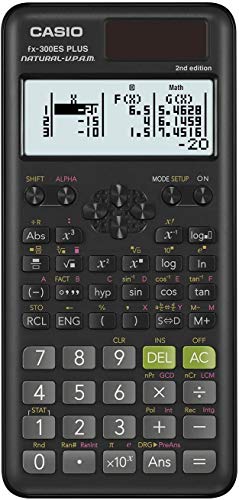
Not every GCSE student needs 417 functions. If your focus is squarely on the core GCSE Maths syllabus and you want a dependable, easy-to-use calculator at a budget-friendly price, the Casio fx-300ES Plus 2nd Edition is a smart buy. It covers 262 built-in functions, which is enough for everything from algebra and trigonometry to statistics and regression analysis.
The Natural Textbook Display makes fractions, roots, and expressions look just as they would in your textbook or on an exam paper. There’s also a Two-Function Table feature that lets you calculate and display values for f(x) and g(x), which is useful for anyone studying functions and graphs. Converting between fractions and decimals, simplifying recurring decimals, and running permutation and combination calculations are all handled without fuss.
The build is lightweight at just 0.23 pounds, and the sliding hard case protects the keypad from the daily punishment of school life. Solar power is the primary source, with battery backup keeping it reliable in low-light settings. We found the overall usability to be excellent for its target audience: the layout is clean, the labels are clear, and the learning curve is gentle enough for first-time scientific calculator users.
Key Specs:
- Functions: 262
- Display: Natural Textbook Display, LCD
- Power: Solar Plus with battery backup (1 LR44, included)
- Weight: 0.23 lbs
- Dimensions: 6.38″ x 3.13″
- 262 functions covering the full GCSE syllabus
- Solar plus battery dual power
- Very affordable price point
- Lightweight with protective sliding case
- No graphing capability
- Fewer advanced functions than higher-tier Casio models
5. Helect 2-Line Engineering Scientific Calculator: The Budget Backup

The Helect 2-Line Scientific Calculator is the most affordable option on this list, and it does what it says it does. For a student on a tight budget who needs a working scientific calculator quickly, it delivers 240 scientific functions, a 12-digit widescreen HD display, and a 2-line layout that shows your input and result at the same time.
The physical design centres on practicality. The buttons are described as scratch-proof, the grip is comfortable, and the solid sliding protective case covers both sides of the device. The body has a no-frills look that prioritises function over style. We found it perfectly capable of handling the basics: trig functions, statistics, exponential calculations, and degree, radian, and grad angle modes.
Where the Helect falls short of the Casio options on this list is in refinement. Some users have noted quirks with the RCL memory function that behave differently from standard Casio equivalents. Battery life has also drawn concerns from some buyers, and the long-term durability is less proven than the Casio lineup. It runs on a single AA battery with no solar backup, which is a consideration for anyone heading into a long exam.
That said, for a student who already has access to school calculators and simply needs a personal backup device, or for a parent who wants a low-risk starting point, the Helect punches above its price.
Key Specs:
- Functions: 240
- Display: 2-line, 12-digit widescreen HD LCD
- Power: Battery (1 AA)
- Screen size: 6.3 cm
- Weight: 180g
- Handles core scientific functions competently
- 2-line display shows input and result simultaneously
- Protective sliding case included
- Battery-only power with no solar backup
- Some memory function quirks reported
- Durability concerns flagged by a portion of buyers
Best Calculators for GCSE Maths: A Quick Rundown
- Casio fx-83GTCW — Best for GCSE exam approval; the only model on this list specifically cleared for every UK exam setting
- Casio fx-991ES Plus 2nd Edition — Best for function depth; 417 functions with dual solar and battery power for students who want room to grow
- Casio fx-115ES Plus 2nd Edition — Best all-rounder with solar; 280+ functions and a 4-line display for easy calculation review
- Casio fx-300ES Plus 2nd Edition — Best value for money; covers the full GCSE syllabus at the lowest price among the Casio options
- Helect 2-Line Scientific Calculator — Best budget backup; affordable and functional for core topics, best suited as a secondary device
Final Thoughts
The most important thing to sort out before you buy is whether the calculator is approved for your specific exam. After that, think about how far you want your calculator to take you. A model that covers the GCSE syllabus and no more is perfectly fine if that’s all you need. But if you’re aiming for A-levels or further study, buying a calculator with more capability now means you won’t have to replace it in a year or two.
Display quality, power reliability, and build durability are the three practical factors that separate a good exam calculator from a frustrating one. Take those seriously, match your choice to your actual workload, and you’ll be well set. The right calculator won’t make you a better mathematician, but it will absolutely stop a poor one from slowing you down.