Chemistry is one of those subjects that demands more from your calculator than most people expect. Between balancing equations, working through molar mass calculations, handling scientific notation, and solving for equilibrium constants, a basic four-function calculator simply won’t cut it. You need something that keeps up with your coursework and doesn’t slow you down in the middle of a timed exam.
That’s exactly why we put together this guide. We compared five of the most talked-about scientific calculators available right now, looking at everything from display quality to function depth to exam eligibility. Whether you’re a high school student tackling your first chemistry class or a college student pushing through physical chemistry, this list has something for you.
By the time you finish reading, you’ll know exactly which calculator fits your needs, your budget, and your study style. Let’s get into the picks.
 How We Selected the Best Calculators for Chemistry
Our team spent time researching and comparing scientific calculators across multiple dimensions. We focused on real-world usability for chemistry students specifically, not just general math performance. That meant looking beyond spec sheets and into how these calculators actually behave when you’re in the middle of a problem.
Here are the factors we weighed most heavily:
- Chemistry-relevant functions: The ability to handle scientific notation, logarithms, exponential functions, complex numbers, and unit conversions is non-negotiable for chemistry use.
- Display quality: A natural textbook display that shows fractions, exponents, and equations as written makes a major difference in accuracy and speed.
- Exam approval: Many chemistry courses and standardized tests restrict which calculators are allowed. We verified eligibility wherever possible.
- Ease of use: A steep learning curve is fine for advanced users, but most students need something they can get comfortable with quickly.
- Build quality and portability: Chemistry labs and long study sessions mean your calculator takes a beating. Durability and size both matter.
- Power reliability: Battery life and backup power options are critical, especially during long exams or fieldwork.
- Value for money: We considered what each calculator delivers relative to its price point, so you can make the smartest investment for your situation.
Every pick on this list earned its place by performing well across most of these factors. Now here’s a closer look at each one.
Best Calculators for Chemistry (Expert Ranking & Review)
Five strong calculators made our final list, ranging from a budget-friendly everyday option to a graphing-capable model for students who need more visual problem-solving tools. Here’s how they rank.
1. Texas Instruments TI-30XS MultiView: The Reliable Everyday Workhorse

The TI-30XS MultiView from Texas Instruments is one of the most trusted scientific calculators in classrooms across the country, and it earns that reputation honestly. For chemistry students who need a dependable, exam-approved tool that handles the basics and then some, this one delivers without overcomplicating things.
What sets this calculator apart is its four-line MultiView display. You can enter and view multiple calculations at the same time, compare results side by side, and scroll back through your work to catch errors. For chemistry problems that involve several sequential steps, that kind of visibility is genuinely useful.
The MathPrint mode is another standout feature. Expressions appear exactly as they would in your textbook, including stacked fractions, exponents, and square roots. That means less mental translation between what you’re reading and what you’re entering, which reduces mistakes during high-pressure situations like exams.
We found the build to be solid and compact. At just over half a pound and sized to fit inside a binder pocket, it goes anywhere without fuss. The dual solar and battery power setup means you won’t be caught off guard by a dead screen mid-exam.
Key Specs:
- Display: 16-digit, 4-line LCD
- Power: Solar and battery (CR2032)
- Dimensions: 7.25″ x 3.38″
- Functions: Statistics, fractions, table exploration, MathPrint
- Exam approved: Yes (SAT, ACT, MCAT, state licensing exams)
- Natural textbook display reduces input errors
- Approved for a wide range of standardized exams
- Compact, lightweight, and easy to carry
- Excellent battery life with solar backup
- No equation solver or matrix functions
- No graphing capability
The TI-30XS MultiView is an excellent starting point for most chemistry students, but if you’re heading into college-level work that demands more computational power, the next option raises the ceiling considerably.
2. Texas Instruments TI-36X Pro: The Power User’s Non-Graphing Pick

If the TI-30XS MultiView is the dependable everyday option, the TI-36X Pro is what you reach for when your coursework gets seriously demanding. This is the most capable non-graphing scientific calculator Texas Instruments makes, and it shows.
The TI-36X Pro handles matrices, vectors, and systems of linear equations with the kind of interface you’d expect from a graphing calculator, not a pocket scientific. There’s a numeric equation solver, a polynomial equation solver, and a system of linear equations solver all built in. For physical chemistry or analytical chemistry courses, that level of functionality is a genuine advantage.
One thing we particularly appreciated is how this calculator manages its multi-line display. All four lines are actively used, so you can see your last three calculations at once. That history visibility is especially helpful when working through multi-step stoichiometry problems or equilibrium calculations where each answer feeds into the next step.
The TI-36X Pro also includes a table feature that lets you define a function and generate a table of y-values for a range of x-inputs. For chemistry students exploring reaction rate equations or plotting equilibrium concentrations, this saves real time. The built-in constants and conversion menu are a bonus that chemistry students will use regularly.
Key Specs:
- Display: 4-line MultiView LCD
- Power: Battery powered (CR2032 included)
- Dimensions: 7.22″ x 3.27″
- Functions: Matrices, vectors, numeric integration and derivatives, equation solvers, unit conversions, built-in constants
- Exam approved: Yes (FE, PE, and many standardized exams)
- Equation and polynomial solvers save significant time
- Built-in constants and unit conversions ideal for chemistry
- Approved for engineering and many academic exams
- Graphing-calculator-level interface without graphing restrictions
- Learning curve is steeper than basic scientific calculators
- Some functions require multiple button presses to access
The TI-36X Pro is a serious tool for serious coursework, but if you prefer a different brand or want solar power reliability built in, the next calculator on the list is worth a close look.
3. Casio fx-115ES Plus 2nd Edition: The Feature-Dense Solar-Powered Contender

Casio’s fx-115ES Plus 2nd Edition is one of the most function-rich scientific calculators available at this price point, and chemistry students in particular have a lot to gain from it. With over 280 built-in functions and solar power as the primary source, it’s built for sustained, reliable use.
The Natural Textbook Display is Casio’s term for what it does best: showing fractions, roots, integrals, and equations exactly as they appear in textbooks. For chemistry students working with rate law expressions, Henderson-Hasselbalch equations, or Nernst equation calculations, seeing the full expression on screen before committing to an answer is a real confidence-booster.
This calculator covers a surprisingly wide range of capabilities for its size. It handles complex number calculations, matrix and vector operations, summation, linear regression, polar-rectangular conversions, and simultaneous equations. We found the multi-replay function especially useful for chemistry work, because you can backtrack through a calculation, edit a single value, and get a corrected result without starting from scratch.
The Solar Plus technology with battery backup means you won’t be reaching for a new battery in the middle of your lab report. The physical design is clean and compact, and the screen, at 6.5 centimeters, gives you a bit more viewing real estate than some competing models.
Key Specs:
- Display: 16-digit, 4-line LCD (6.5 cm screen)
- Power: Solar Plus with LR44 battery backup
- Functions: 280+, including complex numbers, matrices, integration, simultaneous equations
- Dimensions: 9″ x 5.5″
- Exam approved: Yes (FE exam and many academic settings)
- Solar primary power with battery backup for maximum reliability
- Natural Textbook Display matches textbook formatting closely
- Over 280 functions cover all chemistry course needs
- No dedicated toggle for scientific notation display
- White finish shows dirt and wear quickly with daily use
The Casio fx-115ES Plus 2nd Edition is a strong contender for chemistry students who want feature depth and solar reliability in one package. If you also want a built-in notepad to jot down intermediate steps right alongside your calculations, the next pick takes that idea and runs with it.
4. ROATEE 991ES Scientific Calculator with Notepad: The Study Session Multitasker
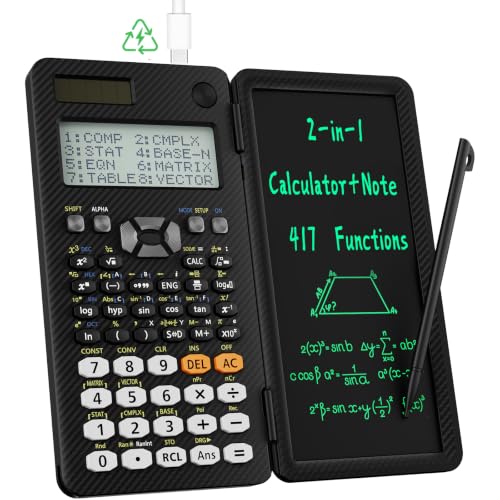
The ROATEE 991ES brings something genuinely different to the table: a built-in LCD writing tablet with a magnetic stylus, right alongside a full-featured scientific calculator. For chemistry students who are constantly juggling intermediate values, unit conversions, and rough sketches of reaction mechanisms, having a reusable scratch pad physically attached to the calculator is more useful than it sounds.
The calculator side packs 417 functions into a 4-line display that shows equations in natural textbook format. It handles everything from complex number calculations and matrix operations to statistical regression and equation solving. Functionally, it compares very closely to the Casio 991ES Plus family, which means you’re getting a capable, well-tested formula set in a new form factor.
The notepad design is thoughtfully executed. A lock and unlock switch on the top edge prevents accidental erasure, which is something many competing notepad calculators skip entirely. The magnetic stylus stores neatly in the lower corner of the calculator side. The writing surface erases completely clean with the press of a dedicated button, so you can reuse it throughout an entire exam or study session.
We also found the anti-drop body construction worth noting. The ABS plastic casing feels more durable than it looks, and the foldable design adds protection to both the screen and the notepad surface during transport. At just 5 ounces, it fits easily in a backpack without adding bulk.
Key Specs:
- Display: 4-line LCD (6.2 cm screen)
- Power: Rechargeable battery (CR5 included)
- Functions: 417
- Dimensions: 6.32″ x 3.28″
- Special feature: Built-in lockable LCD writing tablet with stylus
- Built-in lockable notepad is genuinely useful for multi-step chemistry problems
- 417 functions cover all high school and college chemistry needs
- Anti-drop body with foldable protective cover
- Rechargeable battery reduces ongoing costs
- Notepad writing surface can be hard to read in low-light environments
- Thicker and heavier than a standard scientific calculator
The ROATEE 991ES is a creative and practical solution for students who like to work through problems step by step with notes close at hand. If your priority is having graphing capability without jumping to the price of a premium graphing calculator, the final pick on this list takes a different approach.
5. CATIGA CS-121 Scientific and Graphing Calculator: The Budget-Friendly Graphing Option
UNAVAILABLEThe CATIGA CS-121 sits in a category of its own among this group: it’s the only pick that offers graphing functionality, making it a strong choice for chemistry students who need to visualize data, plot titration curves, or graph reaction rate functions without spending significantly more money.
The CS-121 supports over 360 functions, including fractions, complex numbers, linear regression, standard deviation, statistics, and variable solving. A standout feature is the ability to display graphs and formulas at the same time, which is genuinely helpful for chemistry students working through topics like reaction kinetics or equilibrium shifts where seeing a curve in context clarifies what the numbers mean.
The build measures 7 by 3.3 inches and includes a protective case for the screen and buttons. At this size and price point, the anti-drop body and included case make it a practical choice for students who tend to be hard on their gear. Multiple color options are available, including pink, blue, and white, which many students appreciate when personalizing their school supplies.
One thing to keep in mind: some users report that the graphing functions have a learning curve, and a small number found certain features missing for specific course requirements. We recommend confirming with your instructor that this calculator meets your course’s specific requirements before purchasing, particularly for advanced placement or standardized exam settings.
Key Specs:
- Display: 3-inch LCD screen
- Power: Battery powered
- Functions: 360+, including graphing, statistics, and complex numbers
- Dimensions: 7″ x 3.3″
- Includes: Protective case
- Graphing capability at a significantly lower price than premium graphing calculators
- Displays graphs and formulas simultaneously
- Compact design with protective case included
- Multiple color options available
- Graphing functions may not meet requirements for some standardized exams
- Some users report a steeper learning curve for advanced features
Best Calculators for Chemistry: A Quick Rundown
- Texas Instruments TI-30XS MultiView: Best overall for everyday chemistry use, exam-approved, and easy to learn
- Texas Instruments TI-36X Pro: Best for advanced and college-level chemistry, with powerful equation solvers and built-in constants
- Casio fx-115ES Plus 2nd Edition: Best for solar-powered reliability with 280+ functions and natural textbook display
- ROATEE 991ES with Notepad: Best for students who want a built-in reusable scratch pad alongside a full-featured scientific calculator
- CATIGA CS-121: Best budget graphing calculator for students who need to visualize functions and data without a major price jump
Final Thoughts
Picking the right calculator for chemistry comes down to knowing where you are in your studies and what your coursework actually demands. A well-chosen scientific calculator that covers logarithms, scientific notation, and equation solving will carry most students through high school chemistry with no trouble at all. College-level courses, especially physical chemistry and analytical chemistry, often call for something with more horsepower, including matrix functions, solvers, and built-in constants.
Whatever you choose, make sure it’s approved for your exams, suits how you naturally work through problems, and fits comfortably in your bag. The best calculator is the one you’ll actually use every day, not the most expensive one sitting unused on your desk. Pick the one that matches your real needs, and it will pay for itself many times over.